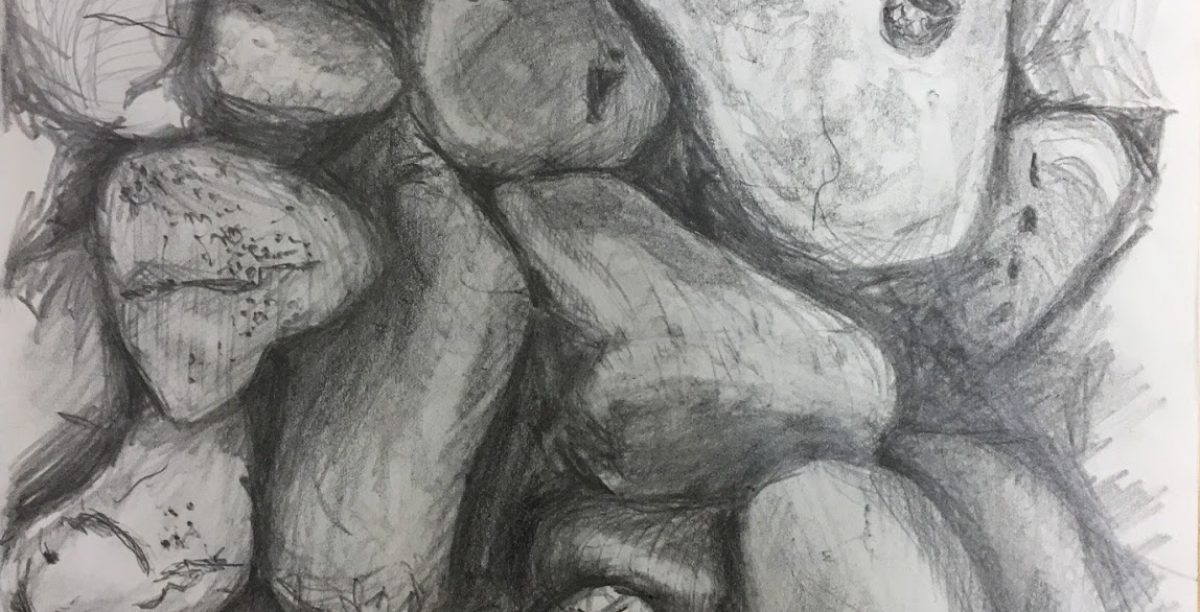
I had this assignment in my mind for several weeks before I actually started the unit. Yet it feels that in a short space of time, this process has been intense; I have bounded so many ideas and concepts around it have been overwhelming at times.
Early on I knew that I was interested in form shape and line, and figures. I found I was looking at the negative space created between objects or people, making an abstraction of new positive spaces and shapes.
This thought process coincided with my reading Arthur J. Miller’s book, Einstein, Picasso: Space, Time, and the Beauty That Causes Havoc (2001). Miller looked at two of the greatest minds of the twentieth century and how they simultaneously had their most important moments of creativity and in relatively similar circumstances. This book reintroduced me to Pablo Picasso’s Demoiselles D’Avignon. I saw so much more to this painting than before, how it was influenced by Picasso’s connection with the mathematician Henri Poincare and a resultant fascination in the fourth dimension – time and its geometrical representation.Thus followed an enjoyment of looking at and playing with negative space and shapes. It felt right, the timing of the book was serendipitous as negative space created by connected beings had been my initial seed of thought.
I digitally played with these thoughts; my ipad allowed me overlap images and see the negative spaces created. I played with line, negative spaces and colour.
Miller highlighted the fundamental link between Picasso and Einstein, talking about time travel; “Gyroscopes are required for the time machine to remain motionless a complex mechanical ether while the rider observes time passes by…much like an observer of one of Picasso’s paintings standing in one place while watching many different representations of an object unfold in time.” (Miller, 2001, p.104-5). Poincare suggested that different perspectives could be illustrated on a canvas; Picasso understood this as perspectives being shown in spatial simultaneity. And this led him to create Demoiselles.
Early on, I had so many ideas and materials, artists and inspiration that my sketchbook was very active to the point it was feeling disjointed and forced. I came to a point where I needed to return to simpler ideas. I was trying to be too precise and perfect, recreating the image in my head rather than going with the evolution of the work.
I experimented with the spaces in Demoiselles and also Matisse’s The Dance. At this point I started to focus on colour theory as I noticed the colours in The Dance were split complementary. This led me to Paul Klee.
At this point I was constantly thinking about this assignment so I ended up dreaming of an image! It was a layered pencil drawing, showing moments changing over time.
I thought that to keep with the layers and the idea of movement, I had to collage. But this became too ‘chunky’ and although effective in some respects, was not showing my drawing skills as it should do in Assignment 5.
After another break and brainstorm, I reflected on the charcoal life drawings I had made on a drawing course a few years ago. I thought this could be a pathway, particularly with Jenny Saville’s fluid charcoal drawings in mind. I returned to my course self-assessment at this stage to hopefully regain direction.
During this time that I broke from this, a cup of tea with a friend gave me a new direction. Human connection and moments frozen in time had me thinking of the placement and movement of the tea cups and biscuit plate.
At this time I also came across Francis Picabia. His layered work reminded me of my earlier digital layered line play. I finally had a clearer vision of my ideas, with Saville’s inspiration satisfying my need for movement.
From this point on the piece evolved rather than followed a rigid plan. I layered a drawing with muted tones to illustrate precious moments caught in time but also its brevity. In turn new shapes were created between these moments.
The piece is made using pencil, charcoal, coloured pencil and chalk pastels. The coloured pencils were wax based so I learned that it becomes harder to draw over the top of the waxiness. In hindsight, I would add the colour last once the layers were drawn in but this defeated the object of creating the pictures as layers; one complete moment in time.


 Tea and Doodles