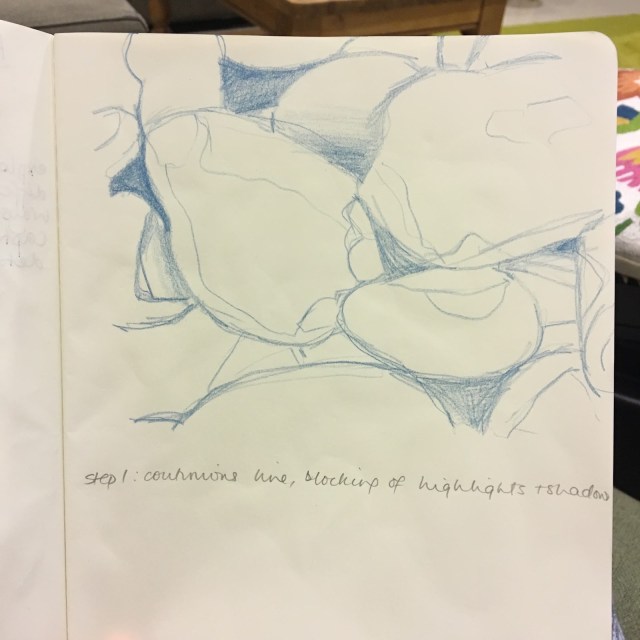
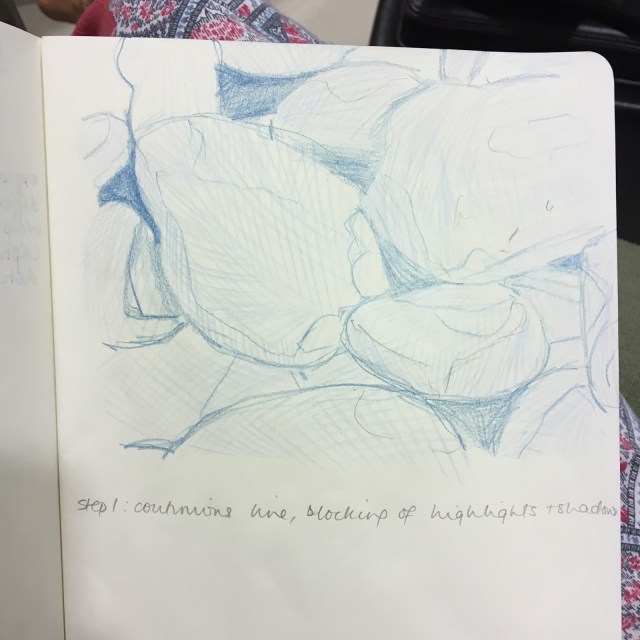
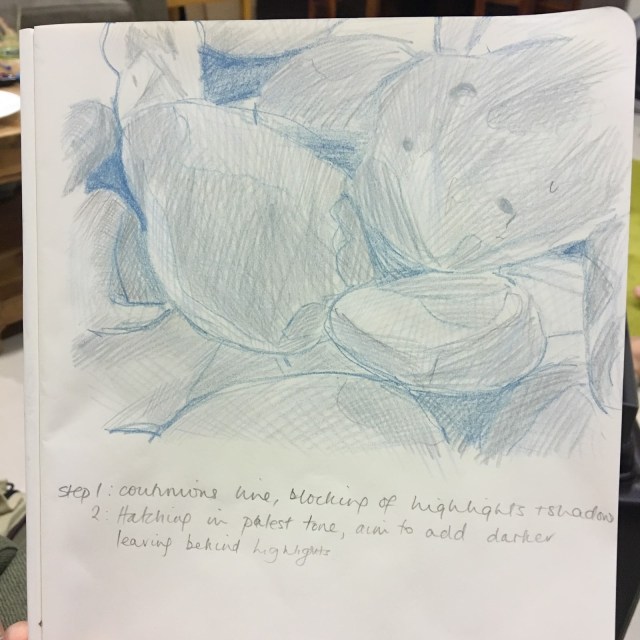
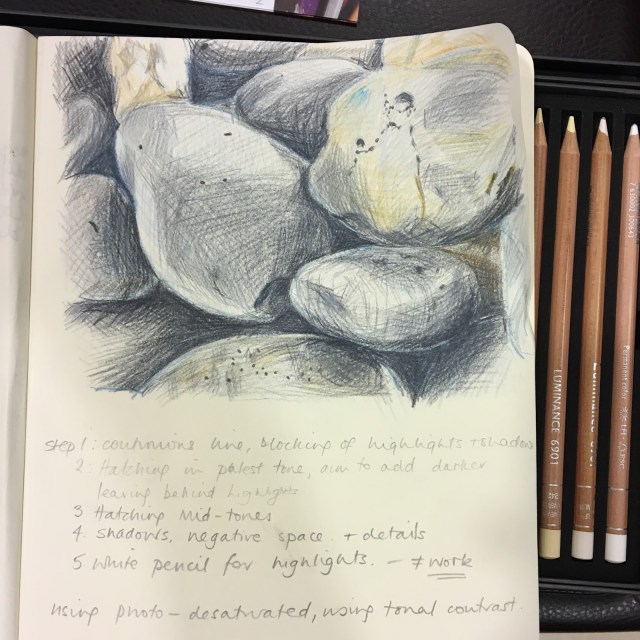
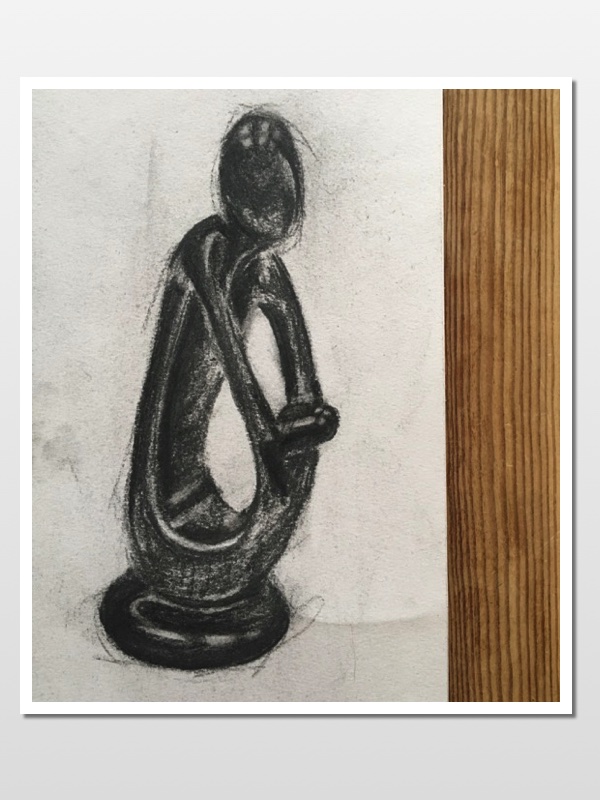
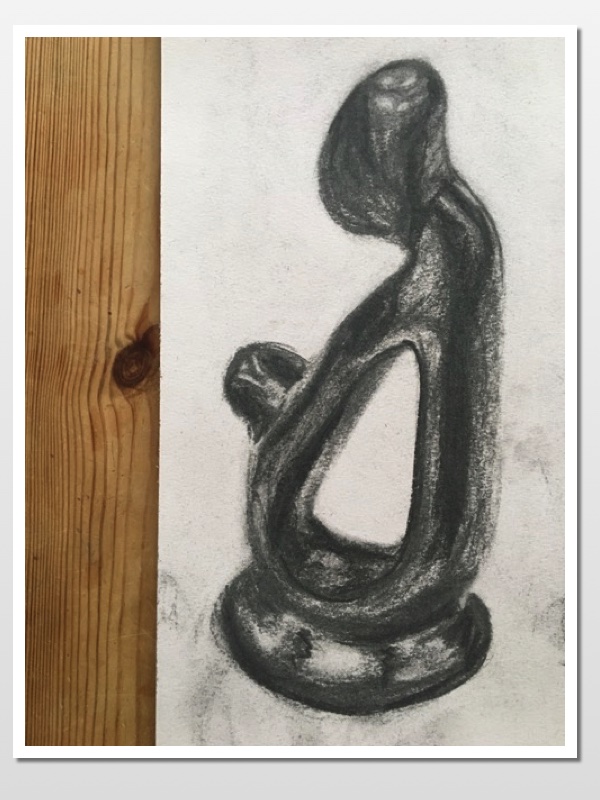
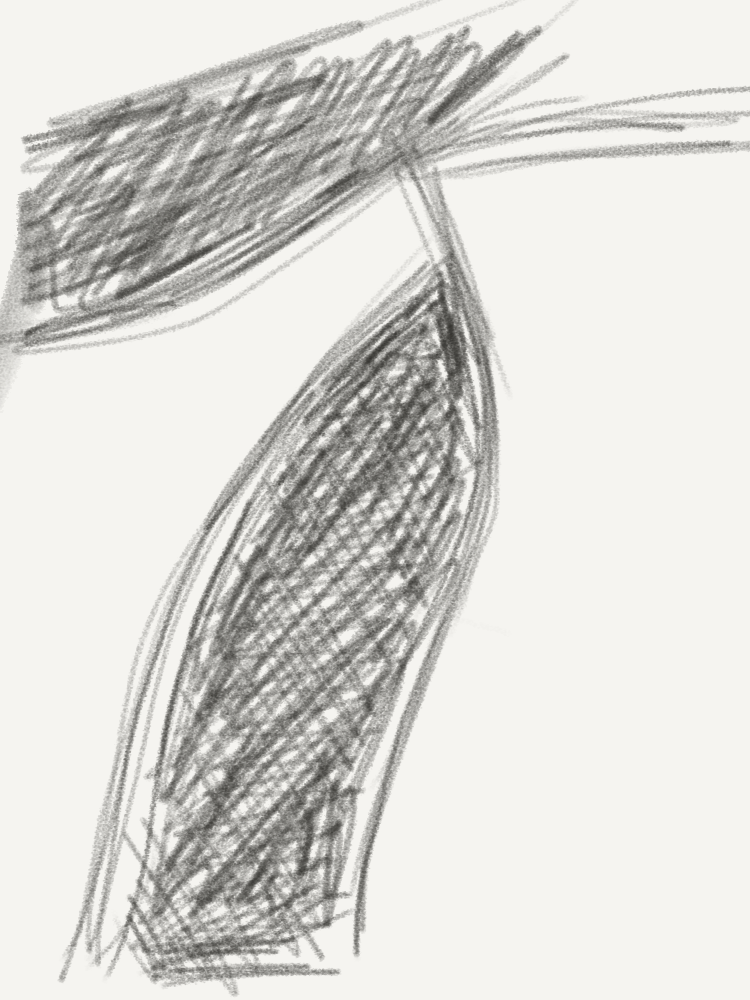
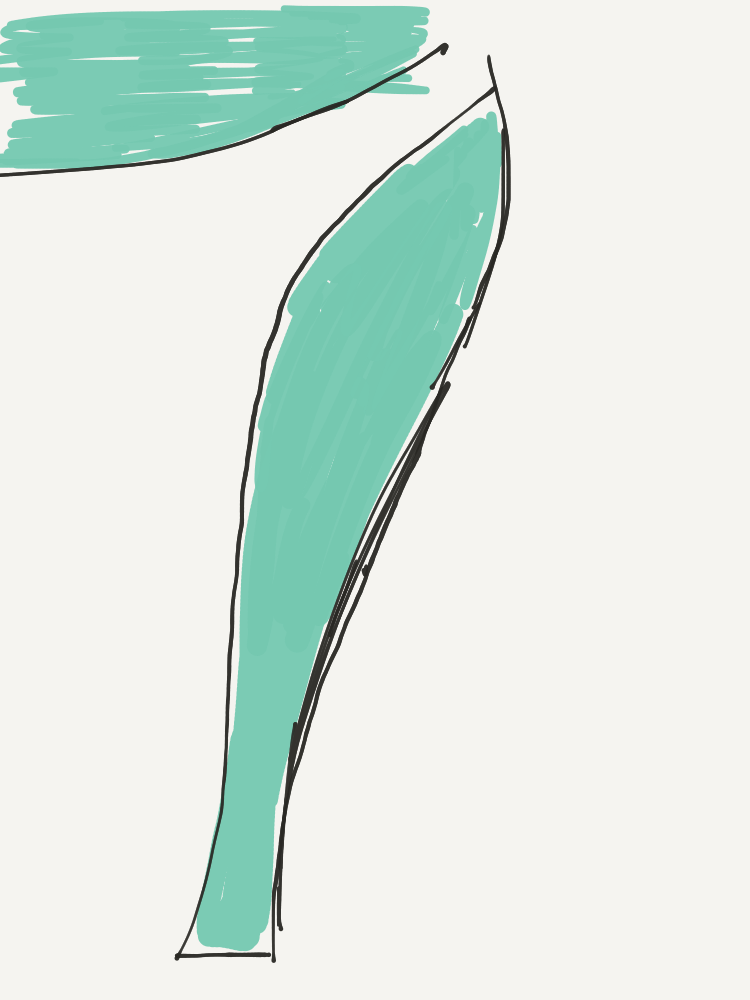
PART 2 Ex 1 – Detail and Tone

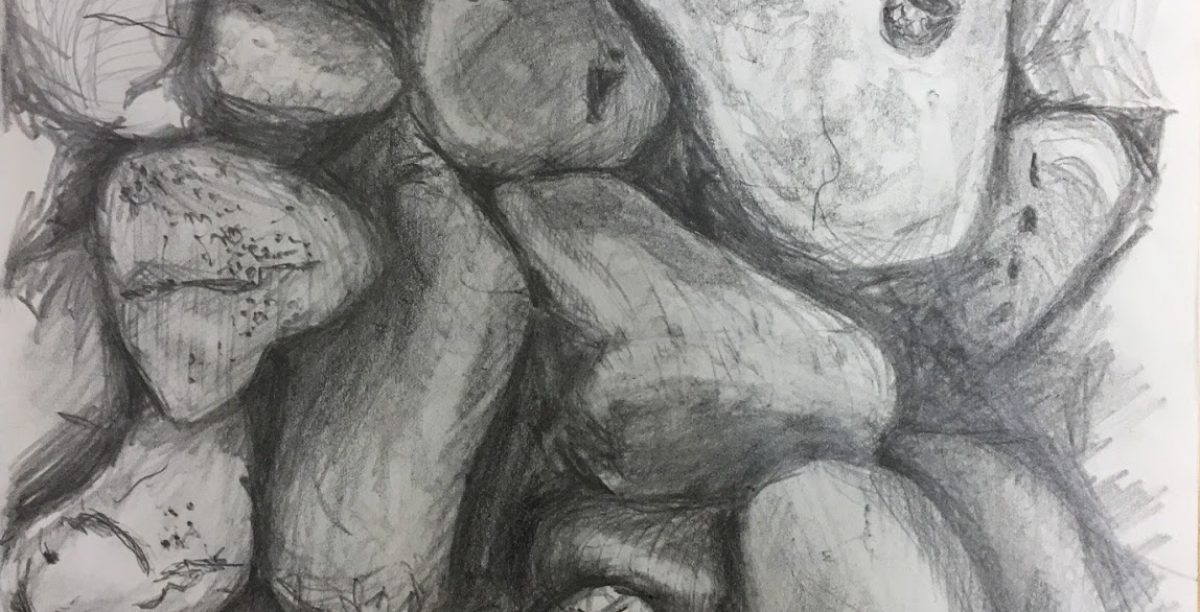
Although this may seem repetitive as we looked at tones and mark making in Part 1, so far I like the way we are being asked to apply it in different compositions, moods and environments. For part 2, it’s all about close work and observational skills with natural objects. I shouldn’t be at a loss for natural objects as I seem to have gained a collection of seashells, pebbles and driftwood. I may need to push myself during this project to think away from the beach environment!

Aims of this exercise:

  • To build up dark, medium and light tones using pencils and crosshatching techniques
  • To use a single object
  • Gain a varied effect by combining soft and medium grade pencils
  • Vary the direction of the strokes made
Method suggested:
  • Lightly sketch outlines
  • Identify darkest areas
  • Hatch in dark areas
  • Identify patterns
Think about:
  • Introducing contrast, strong darks with deep cross hatching
  • Light tone areas
  • Various types of mark direction, continuous and broken line
Practice so far
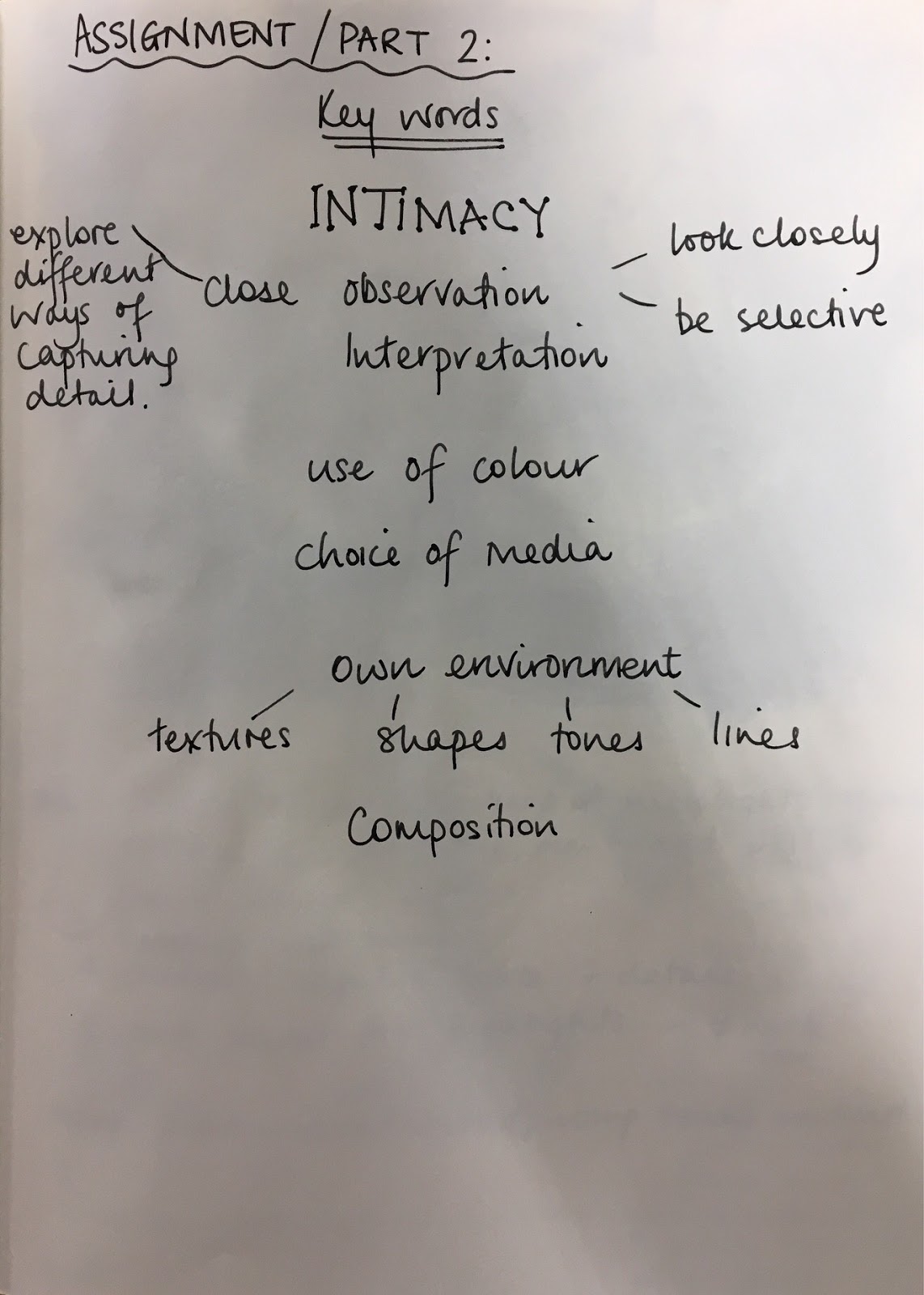
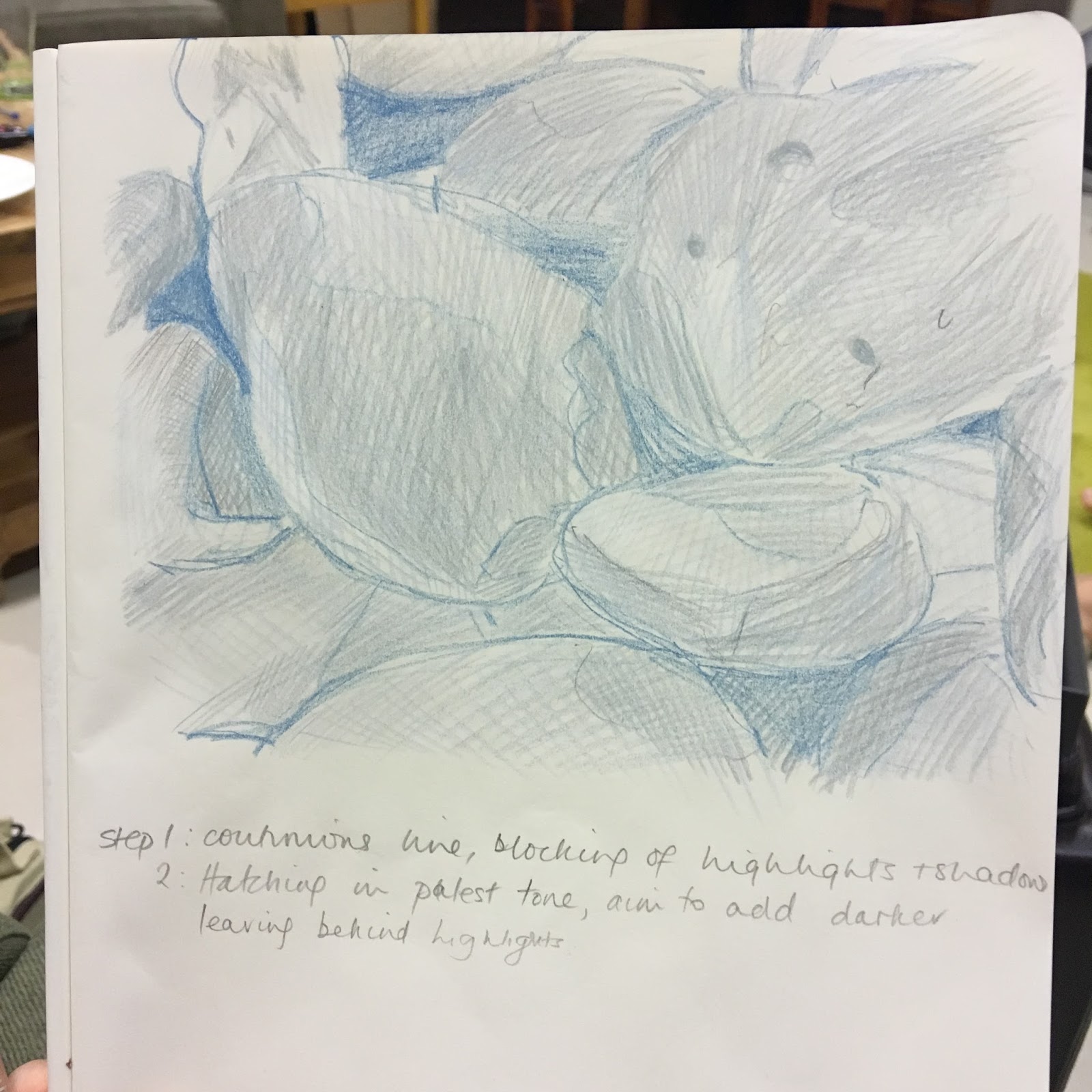
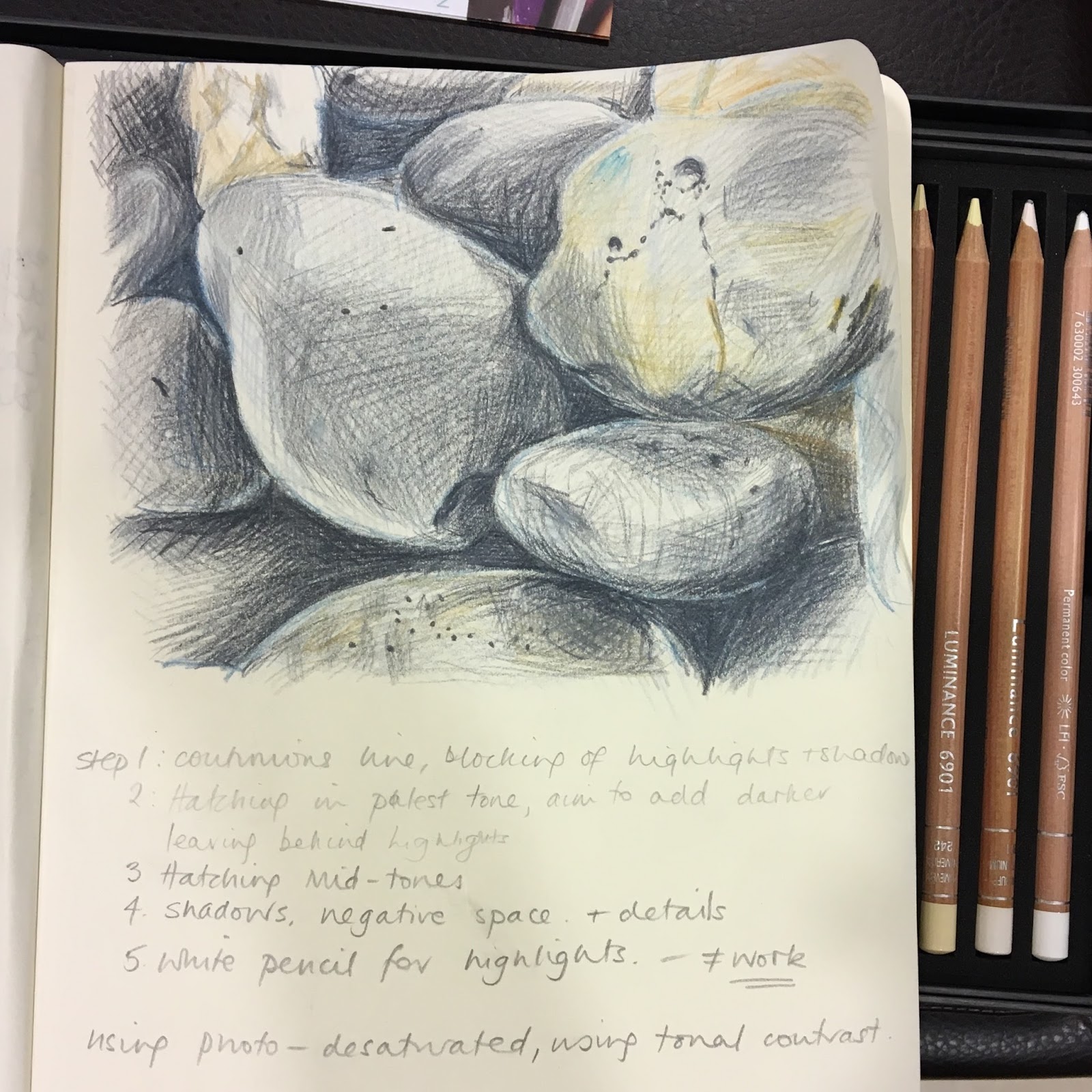
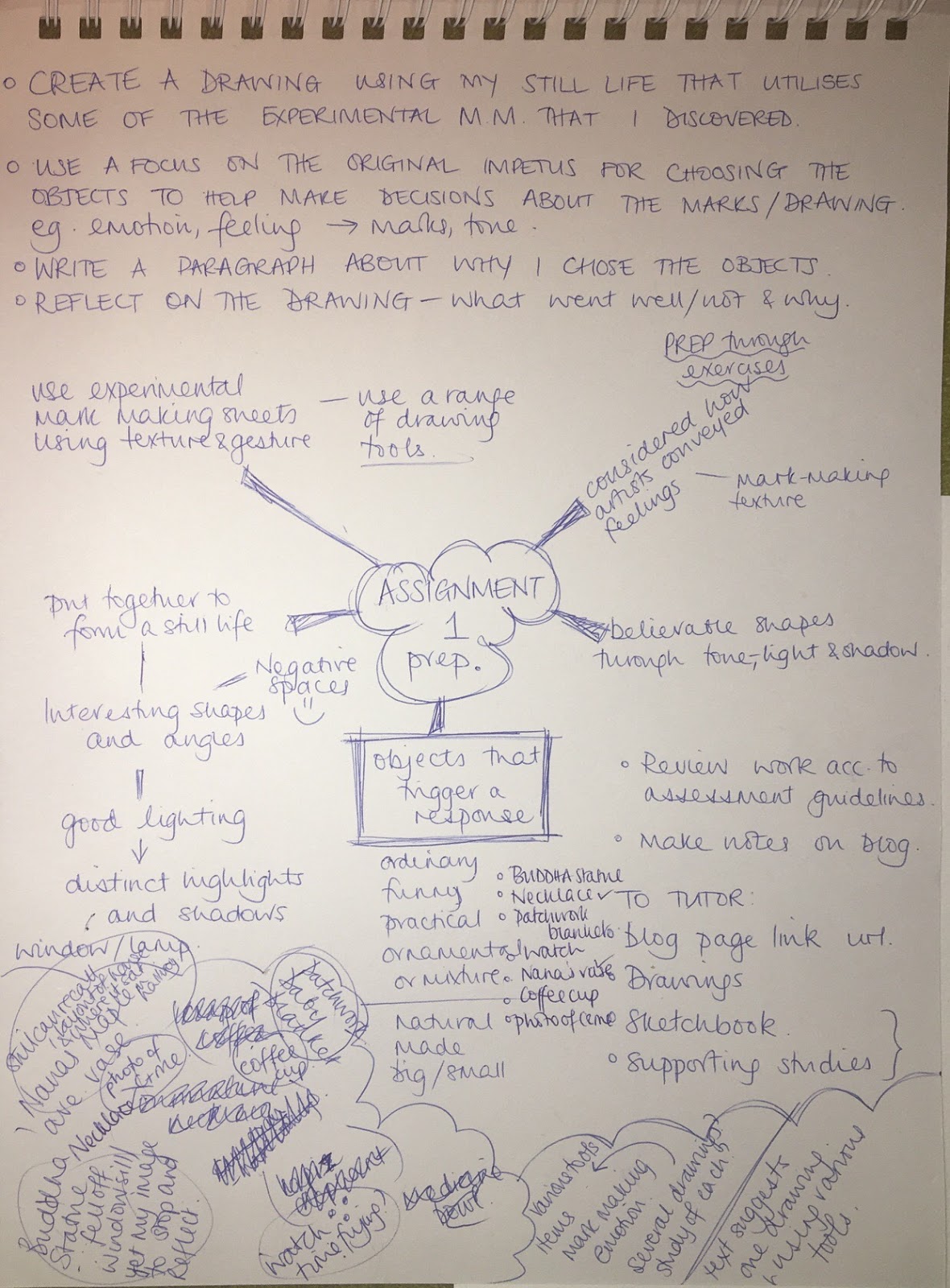
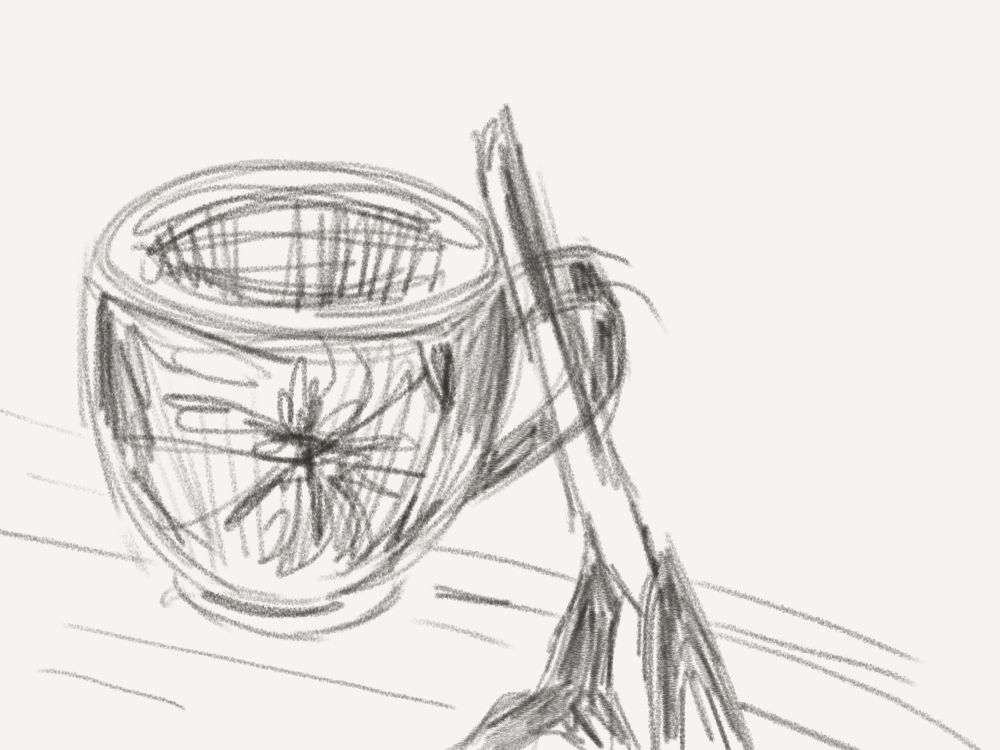
Part 2 objectives in my own shorthand

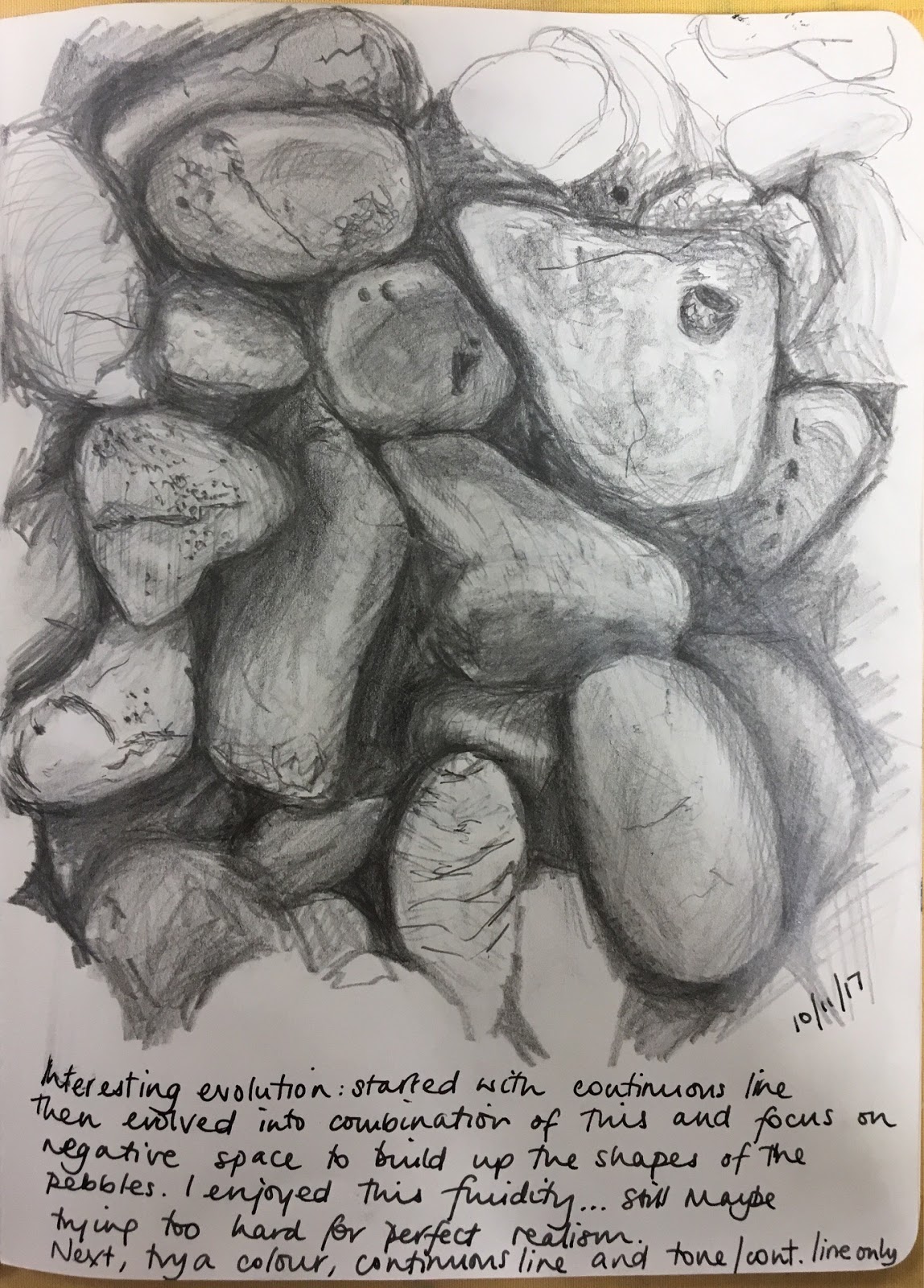
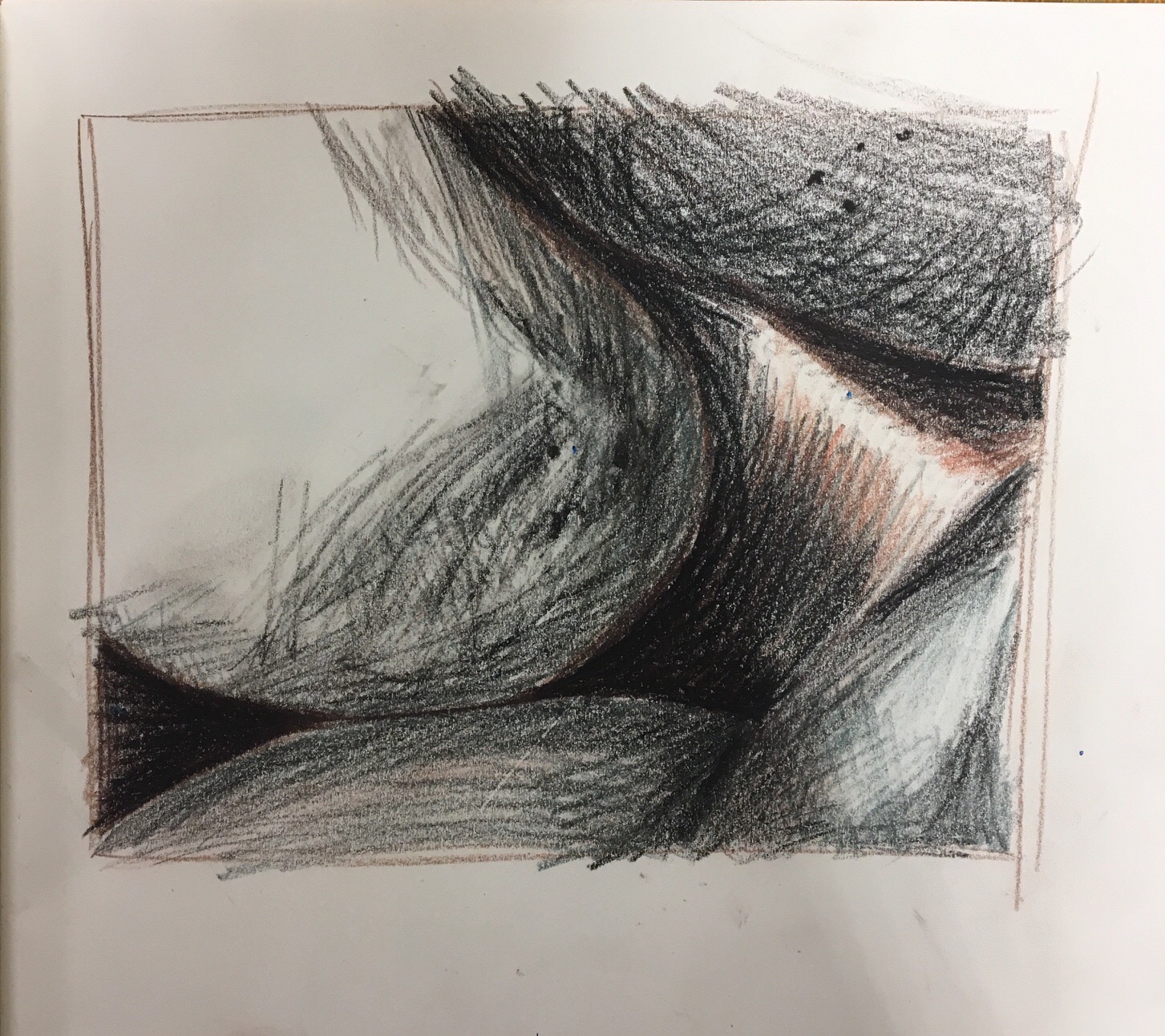
First play 🙂

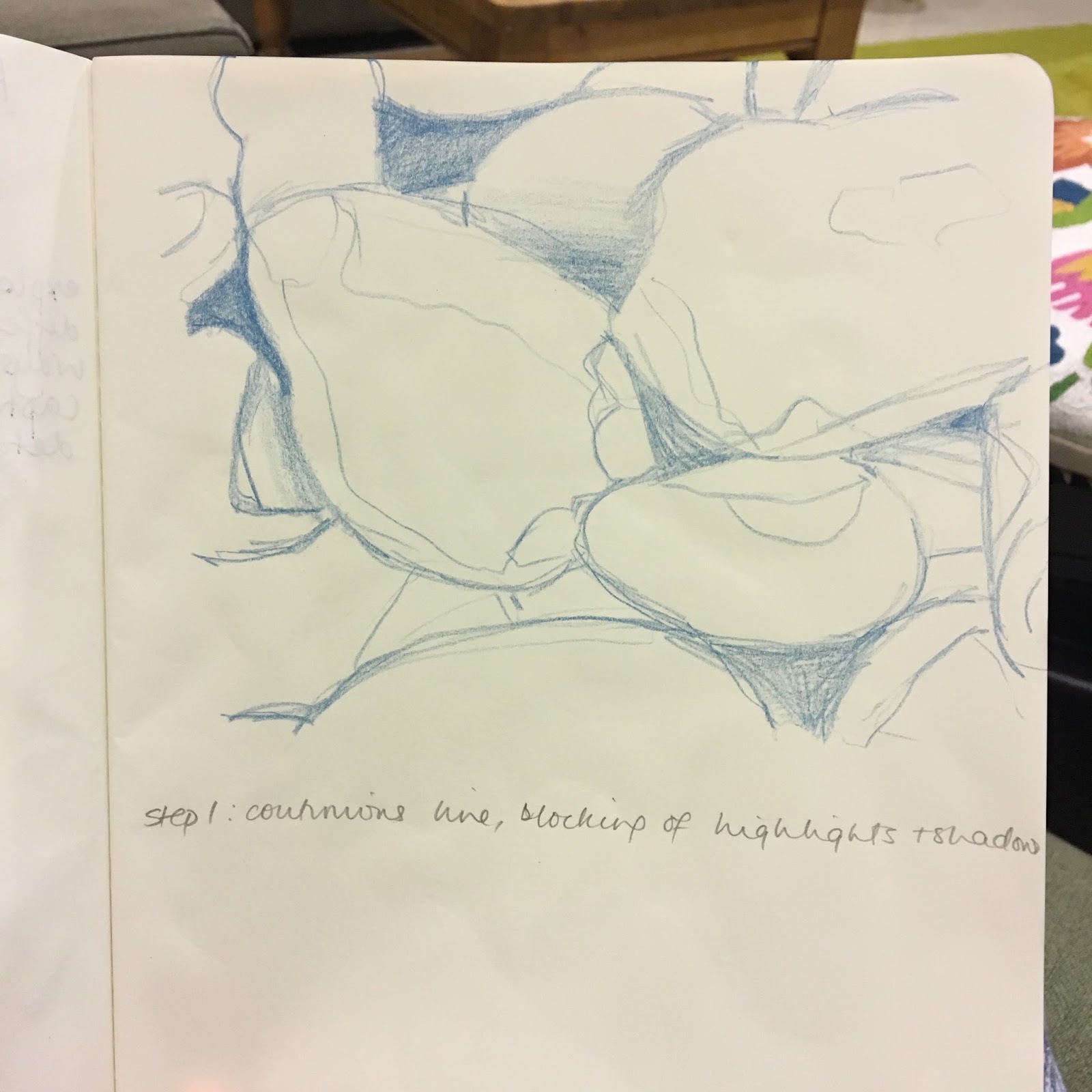
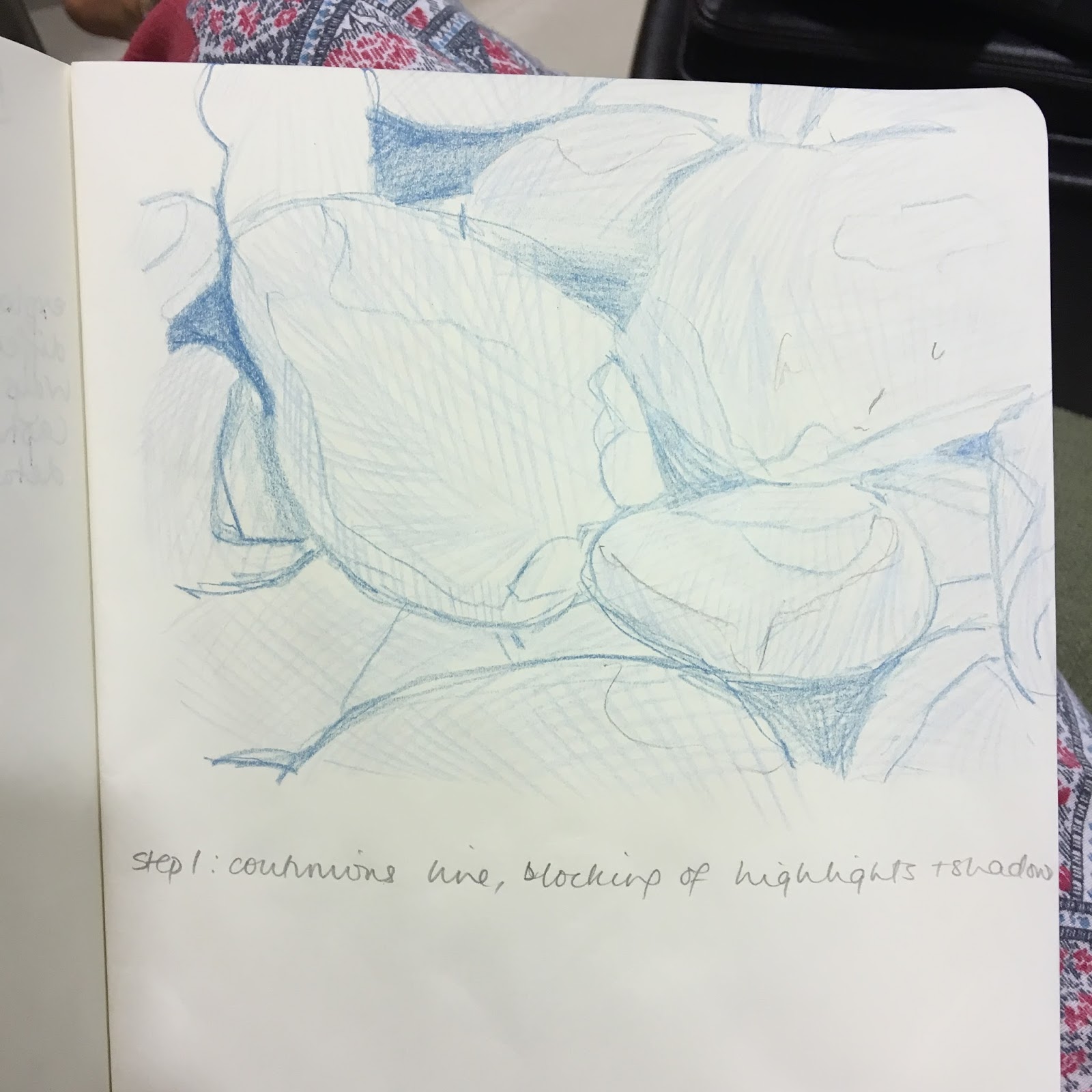
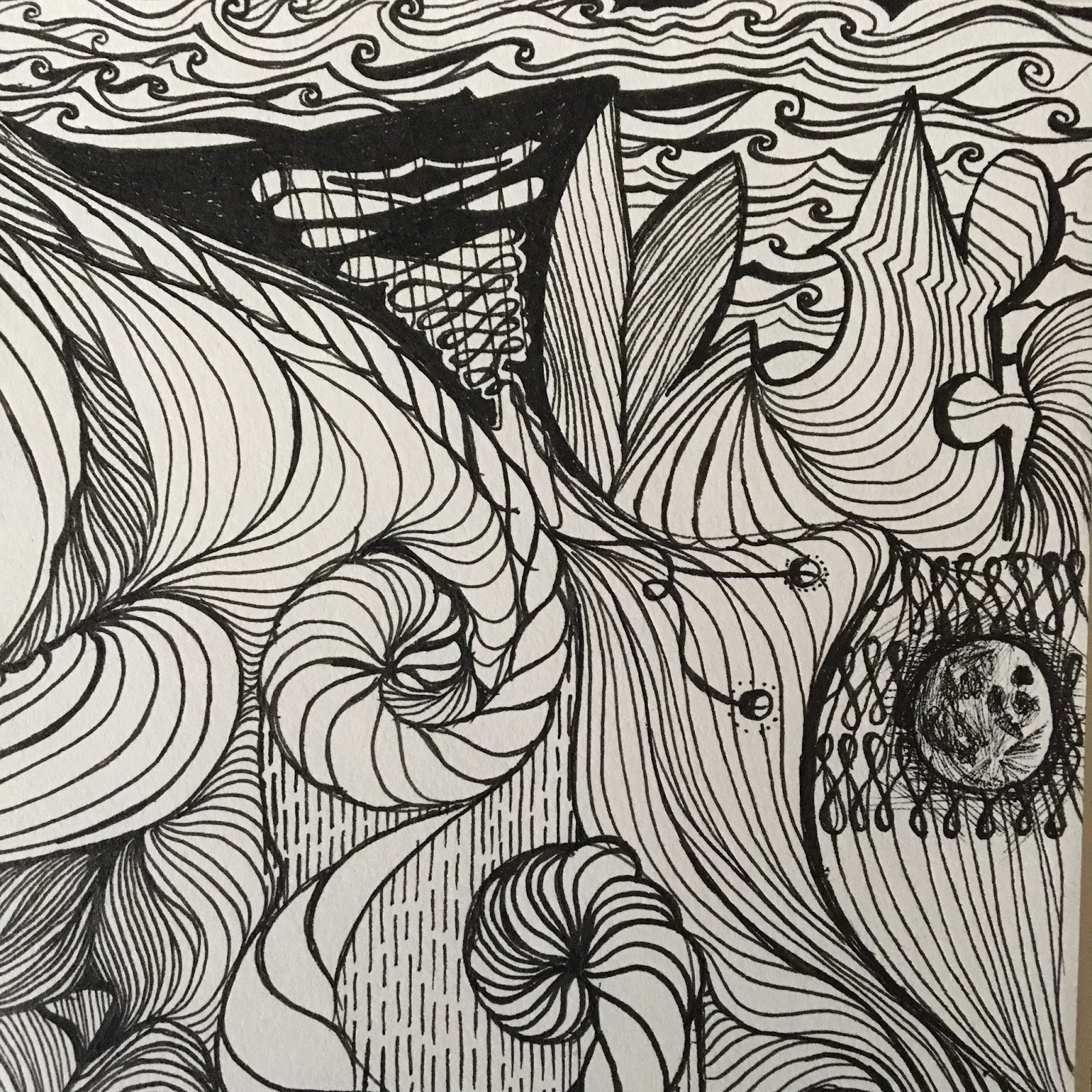
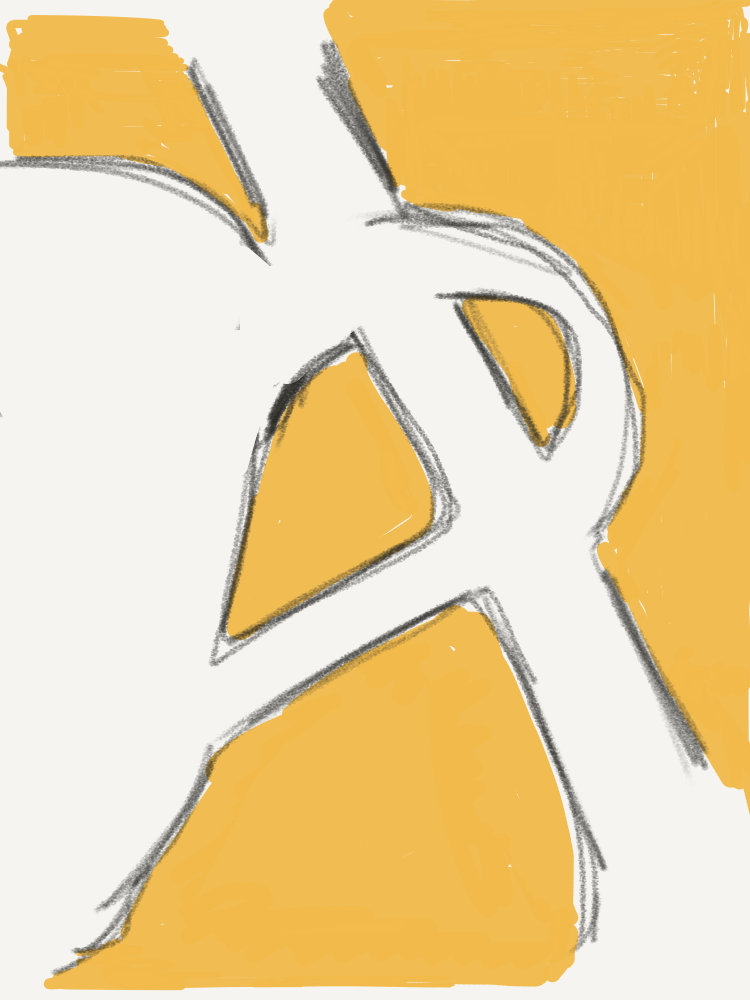
Drawing using negative spaces as a starting point


Completed Assignment 1 & reflection

[post edit: my submitted work for this unit was lost in the post on return to me. I am already thinking of assessment submissions and am so sad that I do not have this unit to include.]
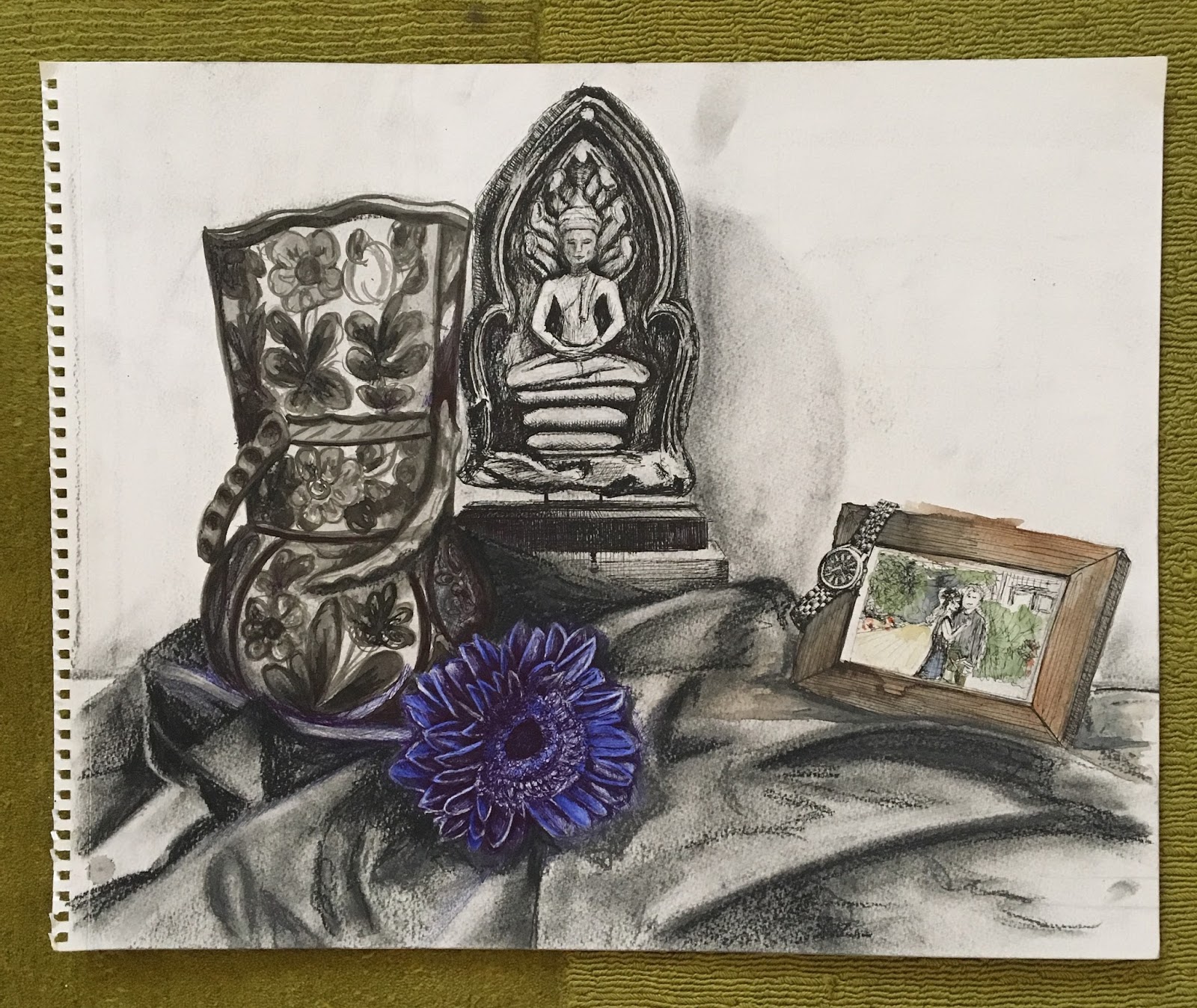
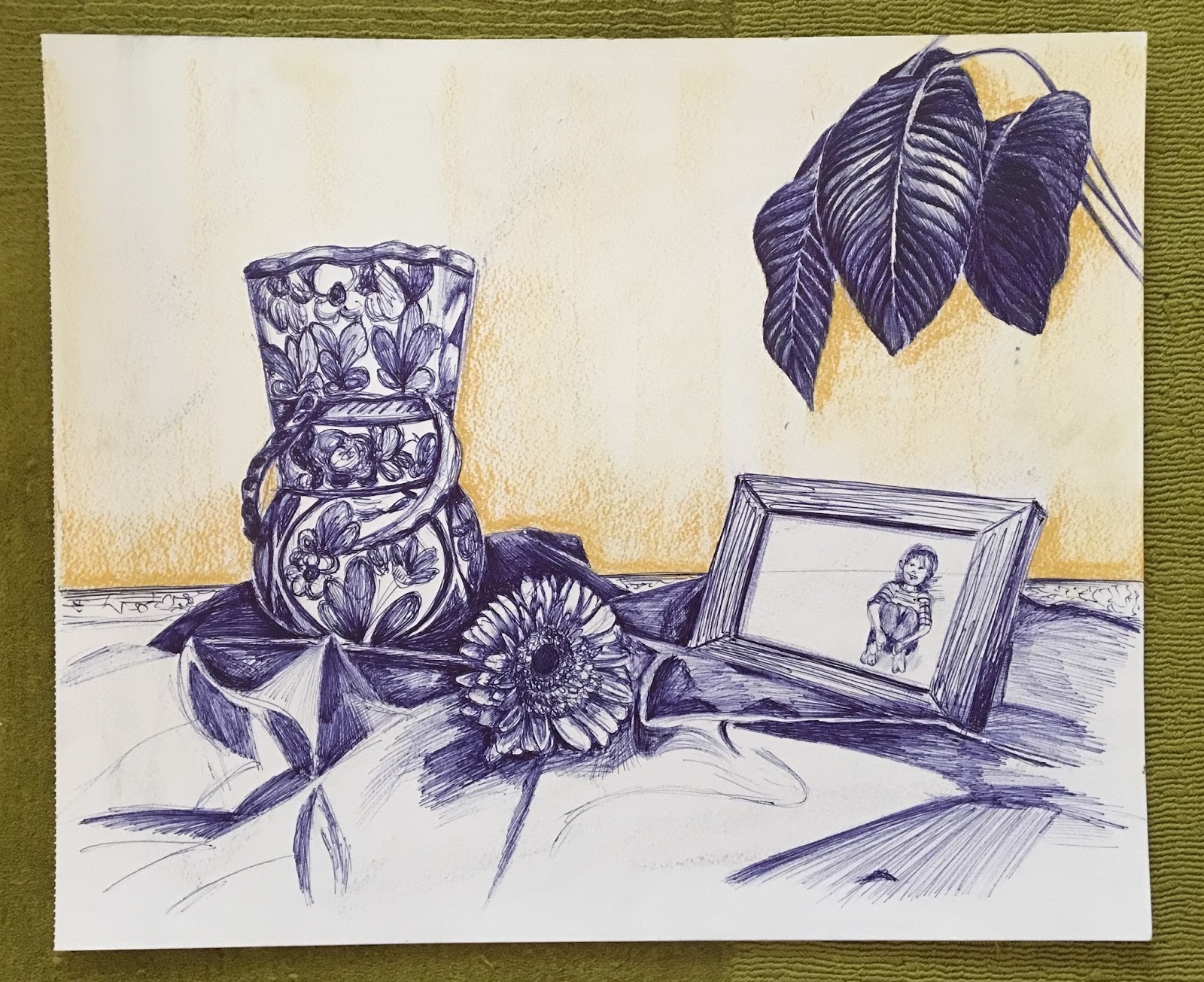
In my previous blog outlining my preparation for the first assignment, I brainstormed several objects around me that meant something in some way. Referring back to the mark-makimg exercises and the emotive response I needed to reflect on, I knew I needed to have a variety of reactions to the objects in order to deepen my drawing response. I  also mentioned that the media I would choose for each object reflect the marks I want to make, I feel they matched the mood I would be trying to create in each part.
 
I see myself as a little nostalgic, happy to sit reminiscing about the smallest thing. I specifically started to look for objects that spark a memory with me.
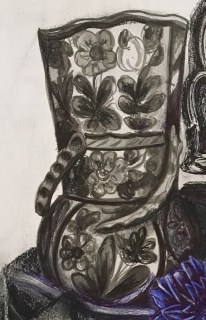
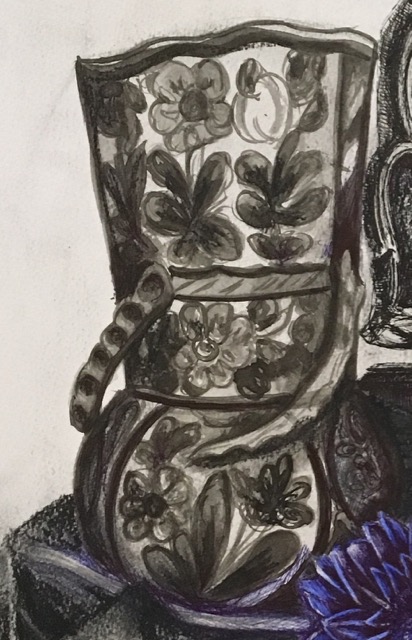
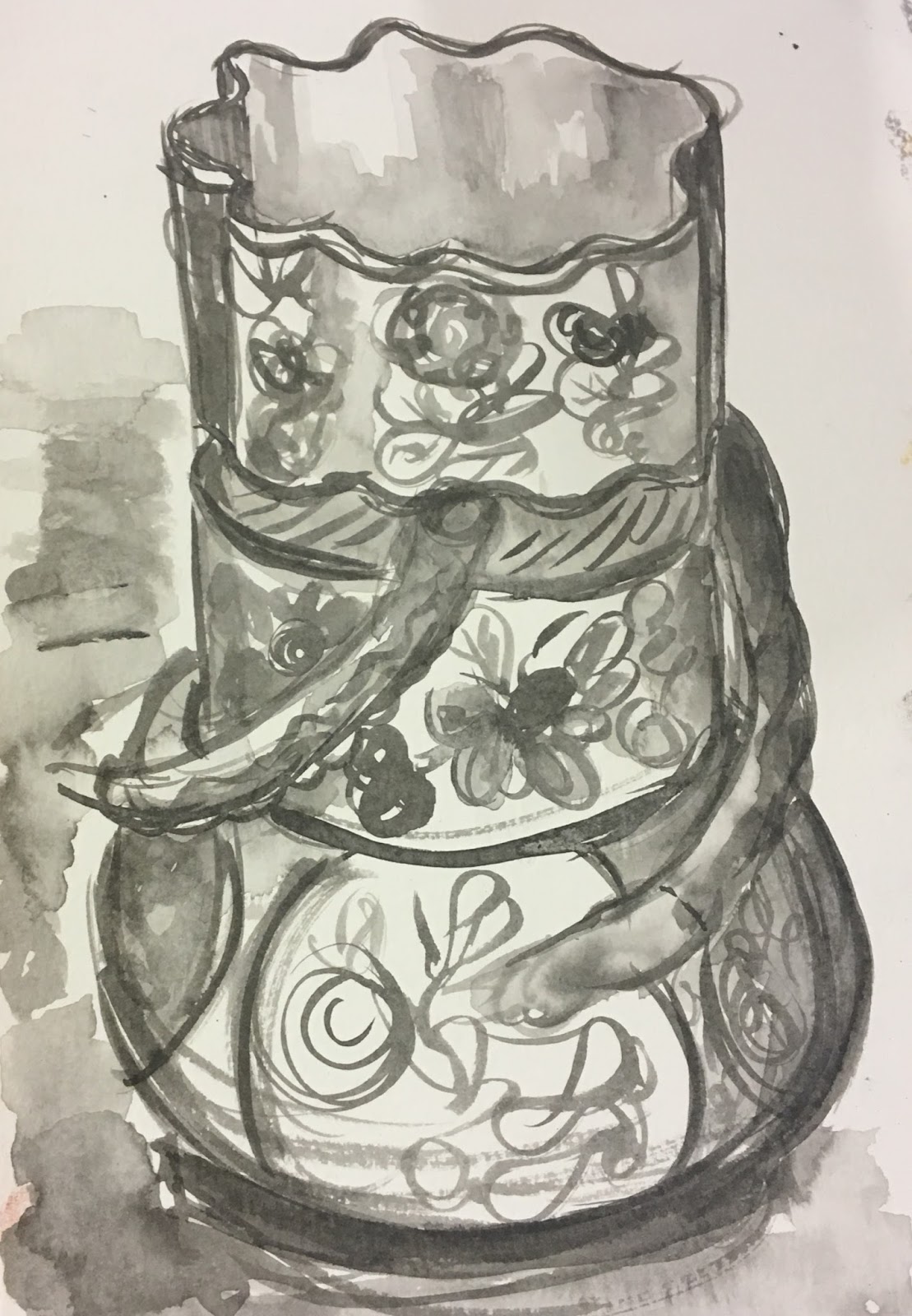
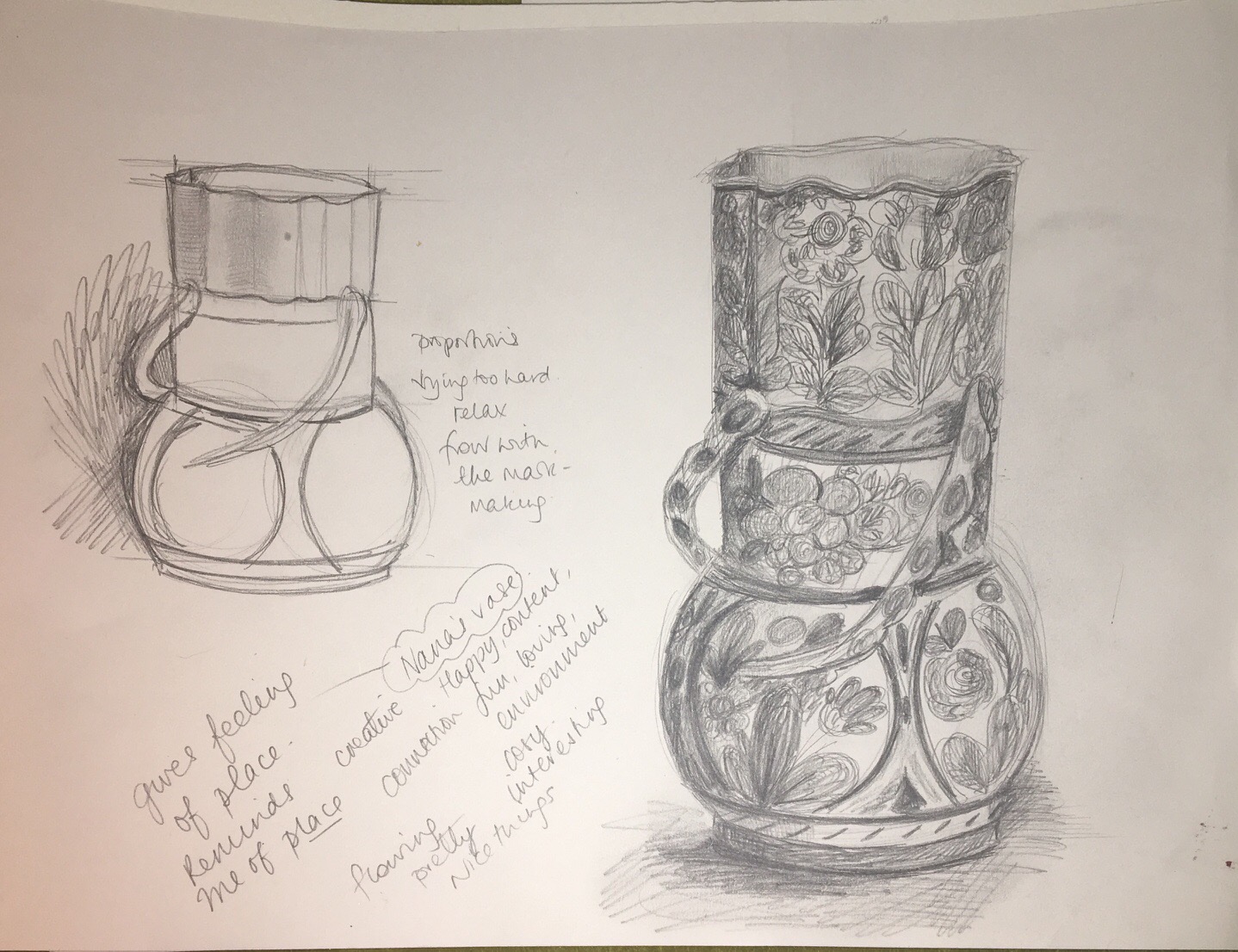
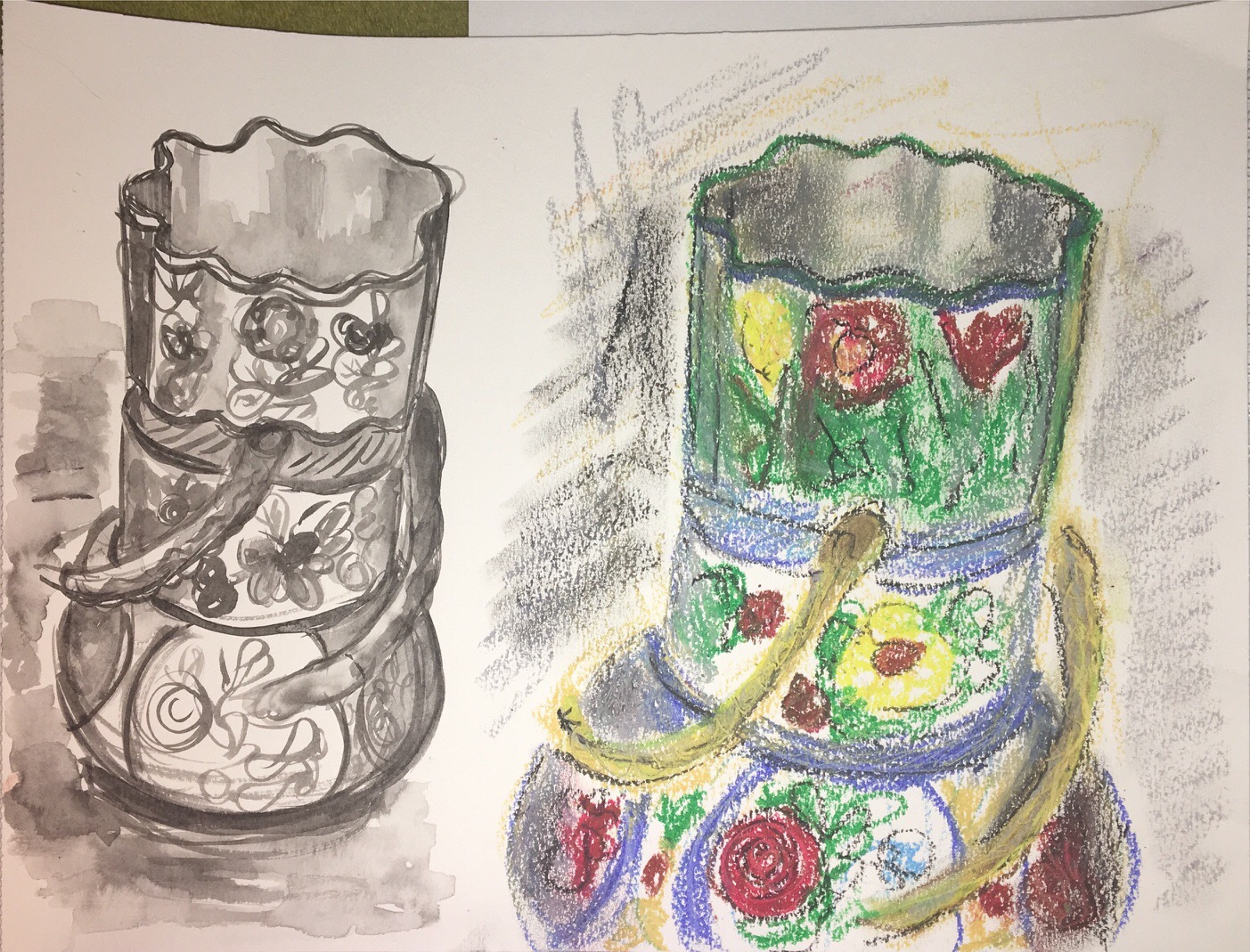
The coloured vase takes me back to my childhood; I remember it sitting in the hallway of my grandparent’s house. It was a gift from my Great Grandad to my Great Nanny. It gives me a feeling of place, a grounding, a sense of belonging in a loving environment. Words I feel when I take myself back – happy, content, fun, cosy, interesting, creative, flowing.  The gesture and marks need to be as flowing and free, and so brush and ink allowed me this movement.

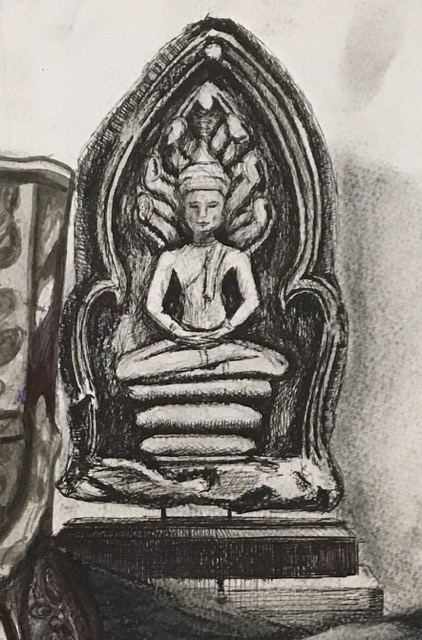
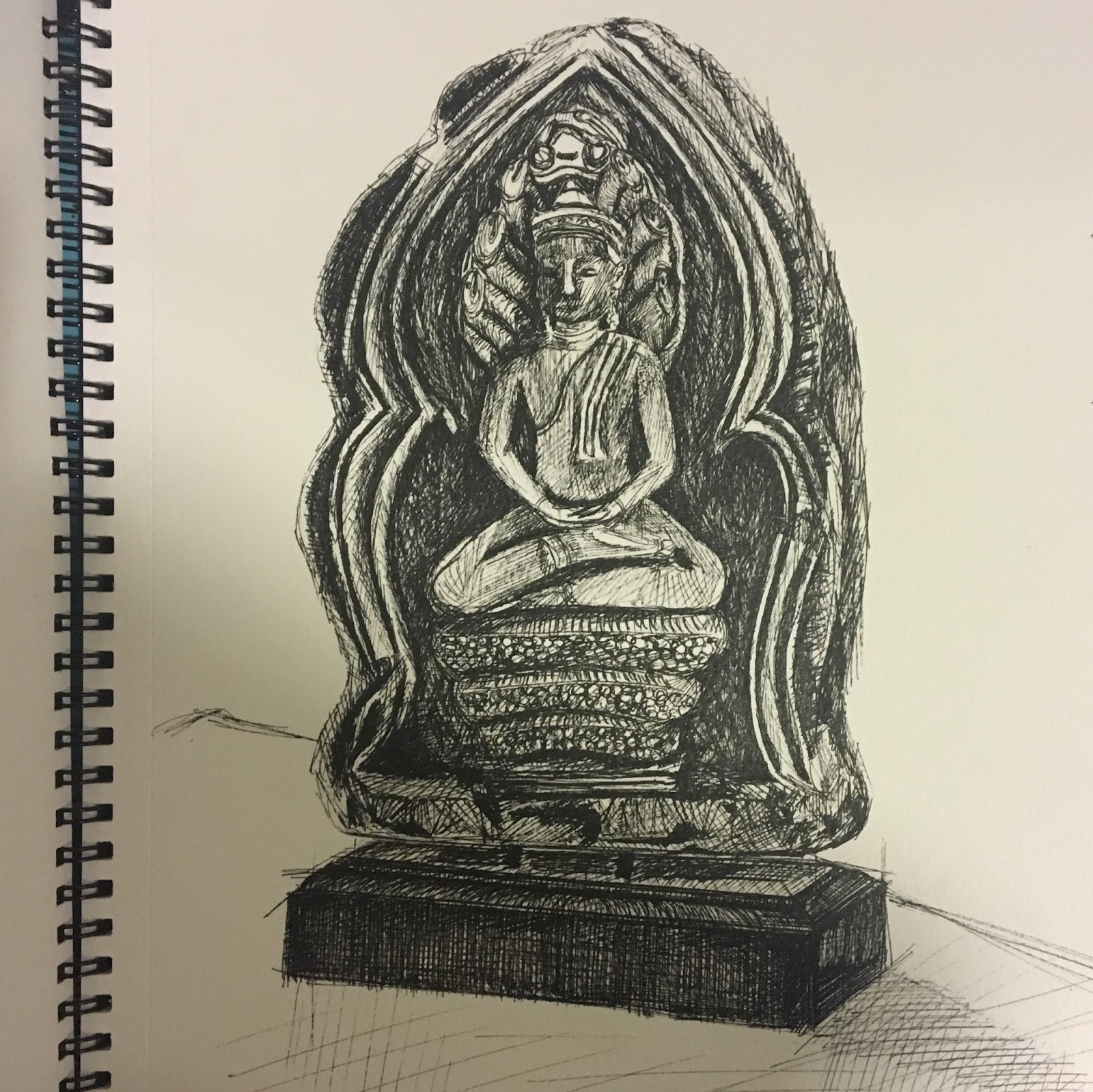
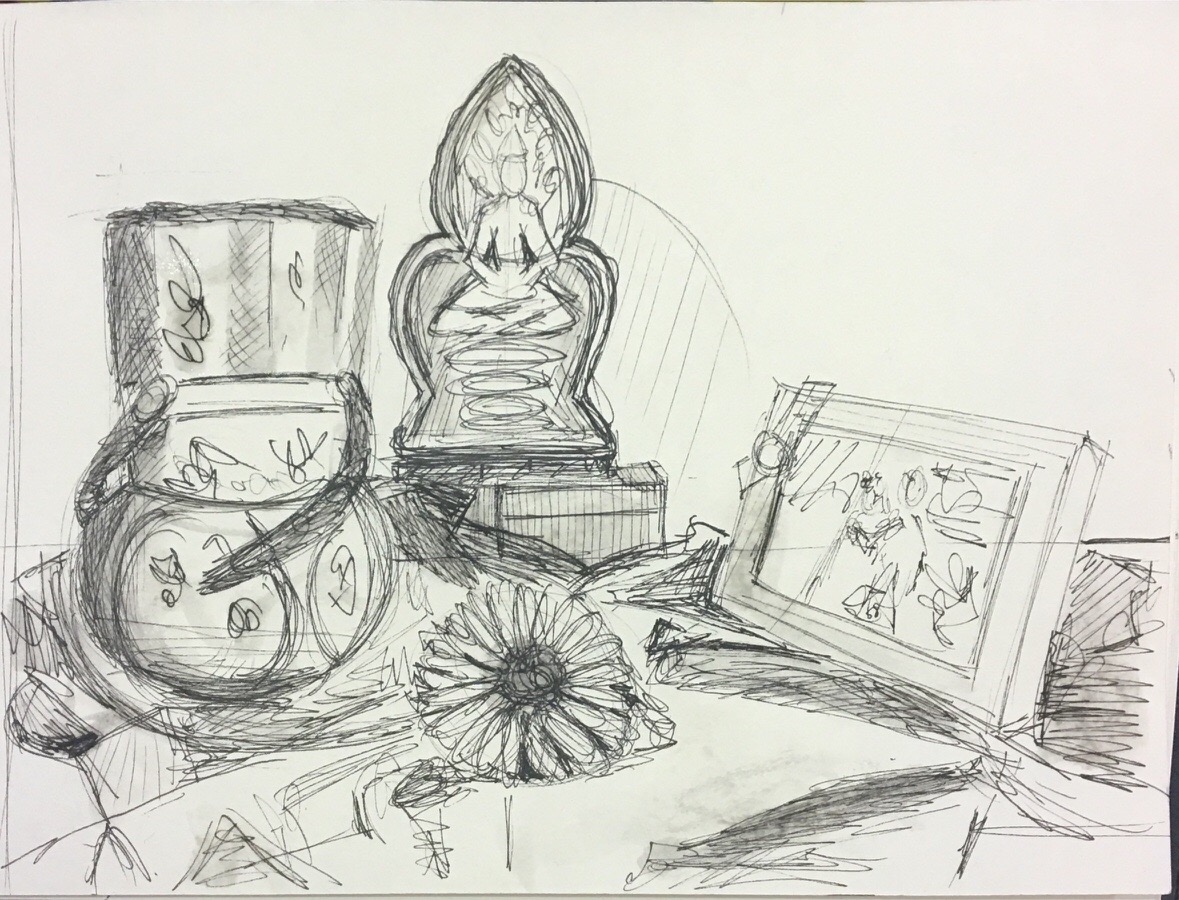
I chose the Buddha statue as it evokes some mixed reactions. I am interested in the Buddhist philosophy and have enjoyed it teachings. This statue reminds me of this peace and structure. However, in a previous house, it had been blown down from the window sill by the blinds caught in the breeze. The stone statue landed on the floor where I usually laid my baby. She was in the cot at the time. There is a chip in it to constantly remind me but also to teach me a lesson! Straight, quick sharp marks with a black pen matched the emotion.
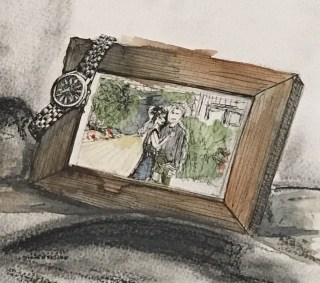
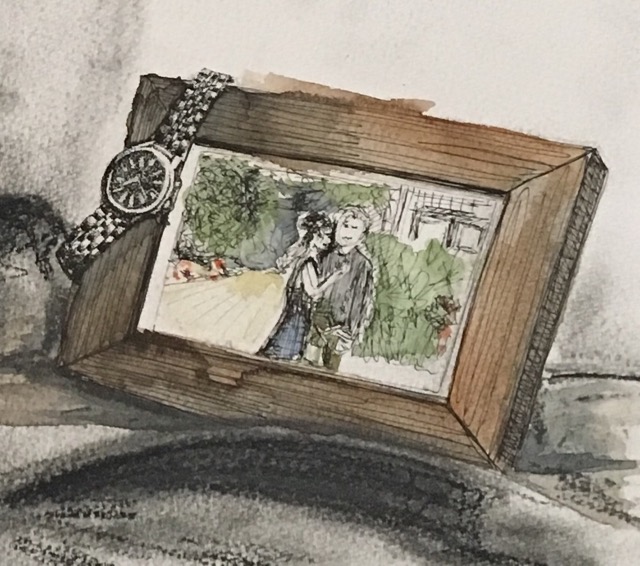
Simple and expressive contour lines for the photo frame helped to reflect a flowing and free time as I was finding my feet in life, shown by the photo taken the first year I met my husband 23 years ago.

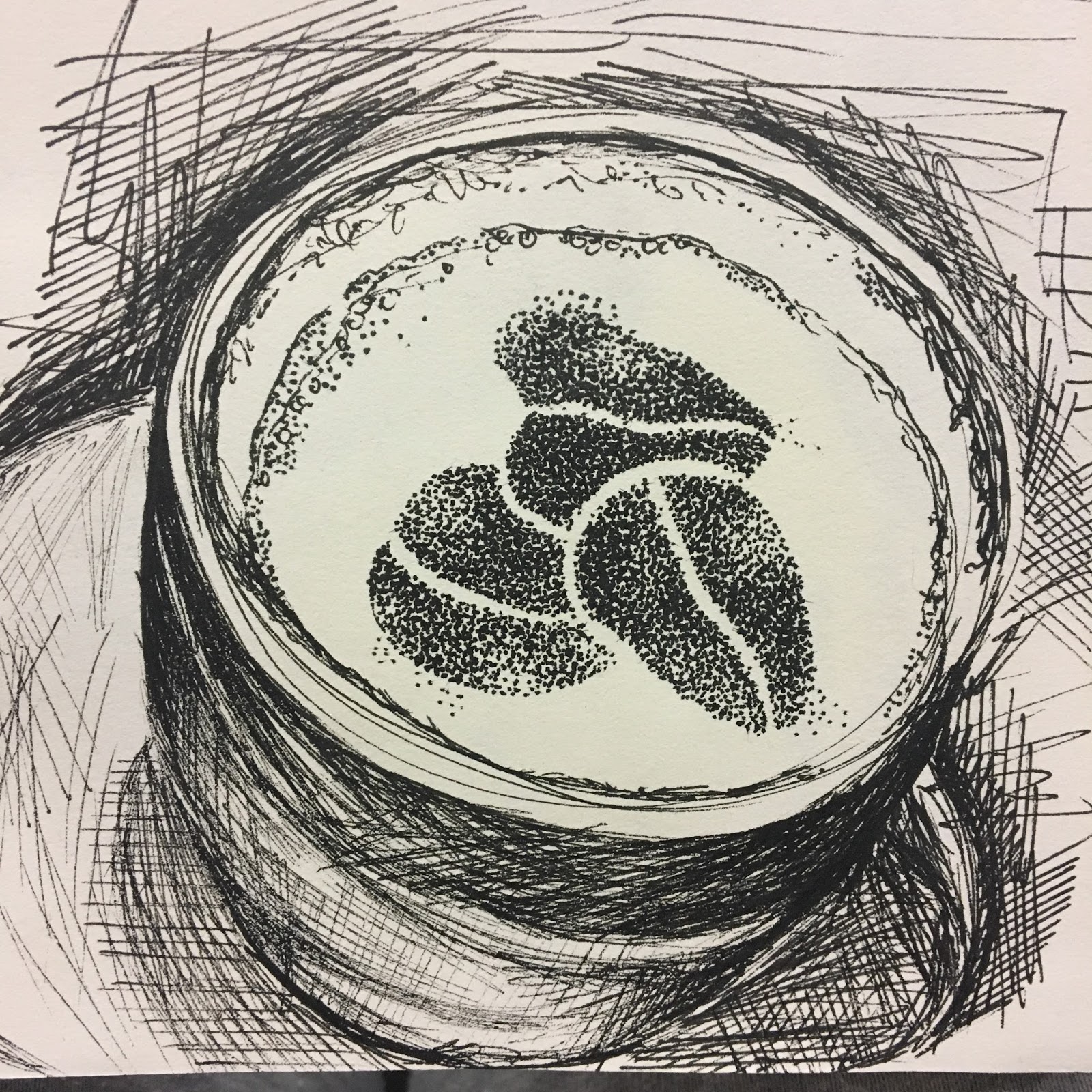
The pointillism in the watch symbolises every movement in the time that I need to acknowledge (I said I reminisce!). Time is such a constraint that we have put on ourselves, that we don’t appear to be in that moment. The objects are on a baby blanket that I made whilst pregnant with my first child. I got so completely lost in making it and so here I was making the moment count. Charcoal allowed a soft, effect to accentuate the tones of the folds of fabric.
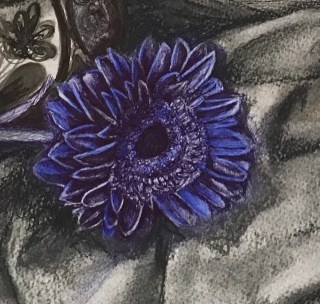
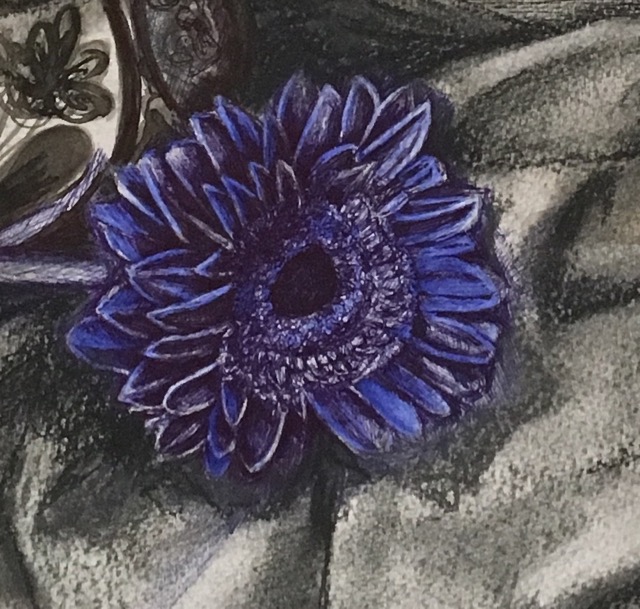
The gerbera was a flower in my wedding bouquet, soft, peaceful but carefree marks to match the memory of young love and laughter. I used a ballpoint pen which I now love. I wanted a contemporary and striking effect and the coolness and glow of the pen helped to gain this.
The assignment text seemed to suggest that I should use a variety of drawing tools and marks. As mentioned before in a previous blog, I thought I would use this obstacle and link the media. It didn’t have the softer effect I was imagining.
Looking back on this first attempt, I realise that a lot of my work needs to have meaning and symbolism. This is obviously no bad thing and is what the assignment text asked, but I would like to work with a spontaneous response to a subject and so maybe this will be possible in future exercises.
However I decided to have another go, making a simpler and quicker response to the objects. Firstly, fewer objects and secondly, using mostly one medium.

So much happier with this attempt, it is not so complex because of fewer objects and one medium. The marks may not be so apparent but the gesture and flow that I drew with reflected the feelings of the object.

Assignment 1 reflection using OCA assessment criteria for Drawing 1

Demonstration of technical and visual skills

I have definitely noticed an improvement in my observational skills over the last few years especially. As a primary school art teacher, I have go back to the basics with the children and find myself relearning along the way with them too. In drawing activities, I direct them to  draw what they really see, and it’s not as easy as it sounds. I find myself often looking at objects wondering how to represent them best in drawing, what material or technique, where are the blocks of light and shadow.

I am getting braver in what material to use and in doing so I hope my perfectionism fades a bit. I would like to be more spontaneous and maybe with a less familiar tool, this would help me be more relaxed as I learn how to use it.

Through teaching the young children, I start to introduce composition to them in its simplest form. I try to apply this to my work but often I become too abstract and random and just try to get a feel for balance along the way. This doesn’t often make for balanced work but it does offer a more fluid spontaneous way of working…hmm, how to get both?!

I purposely planned the composition first of all in this assignment and noticed it didn’t really impede on the rest of my work flow. One bit of effort at the beginning can make for a more flowing drawing. I will make more of my composition planning in future.

Quality of outcome

I am pleased with the outcomes of both attempts, especially the second drawing as it is simpler.  I feel I have managed to capture the light and shadow and also unified the picture to some degree despite using various drawing tools. However, I think I have tried too hard and it’s not ‘fluid’ enough; as I have mentioned before I would like to be more relaxed and spontaneous. I would like to do more with continuous and gestural line drawings. I am surprised about the effect of blue ballpoint pen and am glad I have another tool to my arsenal; I usually can’t stand it when the children write with it, but art is a different matter now!

Demonstration of creativity

I think I have demonstrated creativity in this assignment. I have interpreted the text my own way; I dealt with the original obstacle and thoughts on using more than one drawing medium, I have added personal meaning to the drawing and allowed my mark making to reflect this. I wonder if I could have actually practised my need for fluidity and produced another attempt in such a way. However, I think this owl have lost the original aim of the assignment in that mark-making in response to the text would not have been the focus.

Context reflection

No research was completed in this, it was more about me finding my feet in this module. I enjoyed researching Redon and in hindsight would have looked up and emulated some other artists but all I wanted to do was put my own pencil to paper at this stage. This is the first time I have completed my learning log online so I am still getting used to posting with some frequency. I have also got to get used to the 21st century social media problem of not getting any viewers or comments! I have to remember that is not why I am writing the blog 🙂
PART 1 Planning for Assignment 1 – Still Life

So, I am now working on the first assignment for Drawing 1. It helps me if I rewrote the assignment criteria out in my shorthand and words. It allows me to jot down thoughts and plans as I go through.
Original brainstorm for assignment
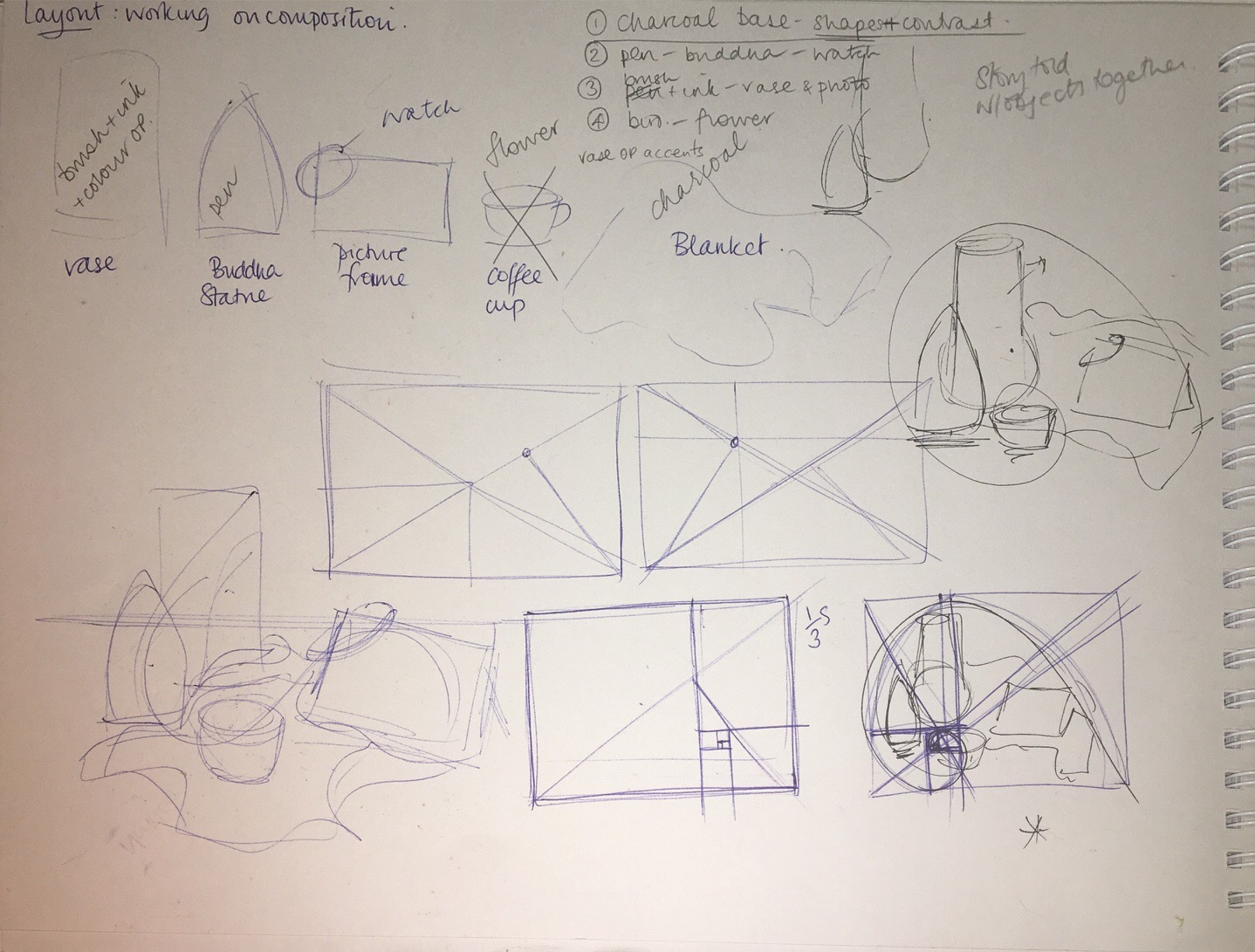
I’ve always felt that I could improve my composition skills, even before I started the art course I am on. I try and run the Golden Ratio through my work but more often than not the work is more abstract, gestural, expressionist and I guess spontaneous. However, this is no excuse not to work on composition, so I need to practise for it to become second nature. I think it probably is, as I am aware of myself ‘eyeing it up’ and feel if it is not sitting right. 
Working on composition, thinking about relative sizes and balance
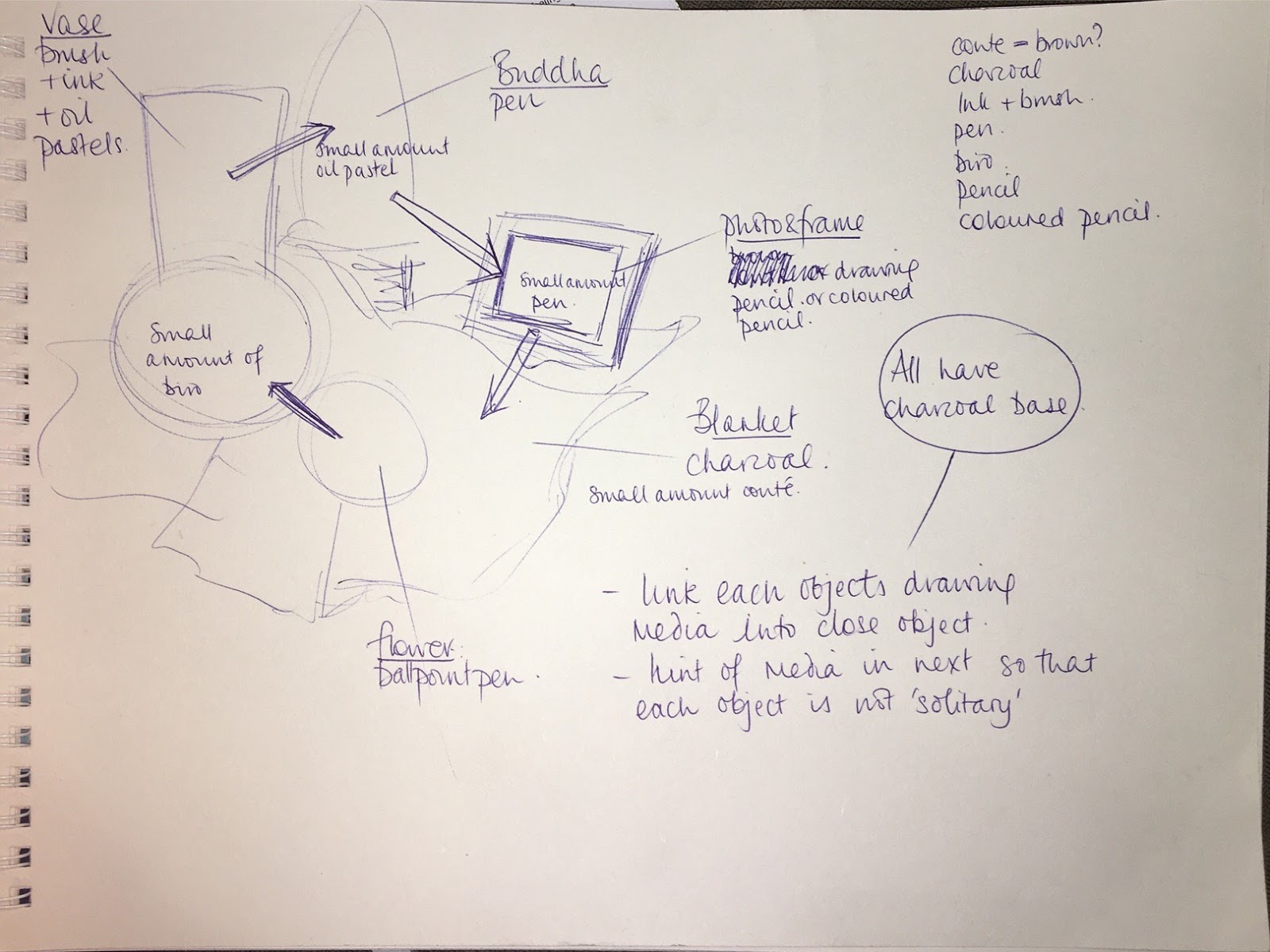
Final layout and plan, thinking about materials to use and how to connect them

Through the various OCA Drawing 1 forums there was some discussion as to the intention and aims of the task. Using various media, create one drawing? Or, create drawings using various media? I originally felt that the first option would lead me to create a rather disjointed drawing, where each component is different to its neighbour. I thought my workflow and process would be stop-start and I would lose my momentum.

However, I thought I might work with this ‘obstacle’ in my assignment. So, yes, use a range of media but demonstrate connection between the objects, i.e. bring a hint of one medium in to another.

The media I have chosen for each object reflect the marks I want to make, I feel they matched the mood I would be trying to create in each part. For example, a drawing pen helps me make quick, hard lines for the Buddha statue (I have mixed feelings about this object which I will expand on in my final reflection!), brush and ink make soft, flowing, relaxed lines on the vase.

PART 1 P2: Exercise 4- Reflective light and shadows. Practice.

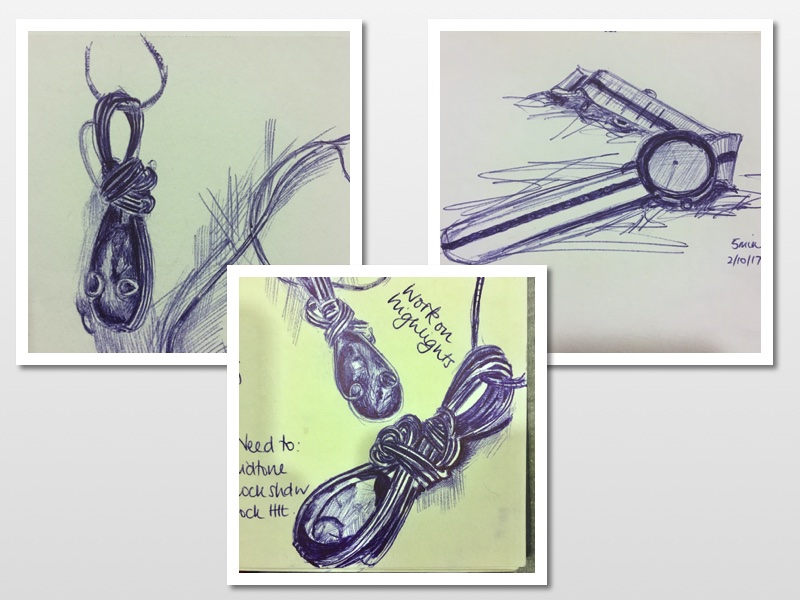
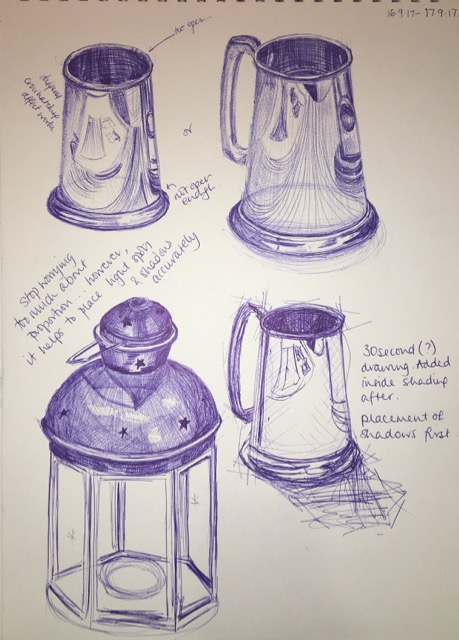
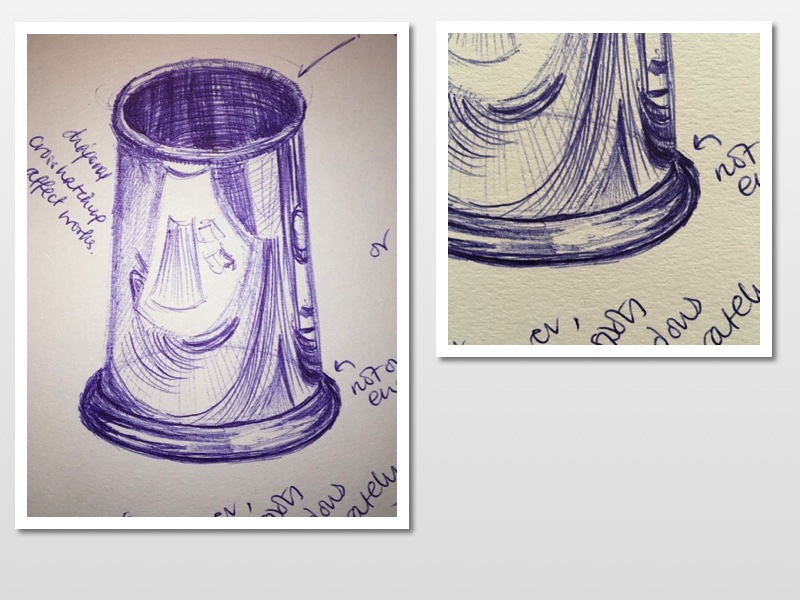
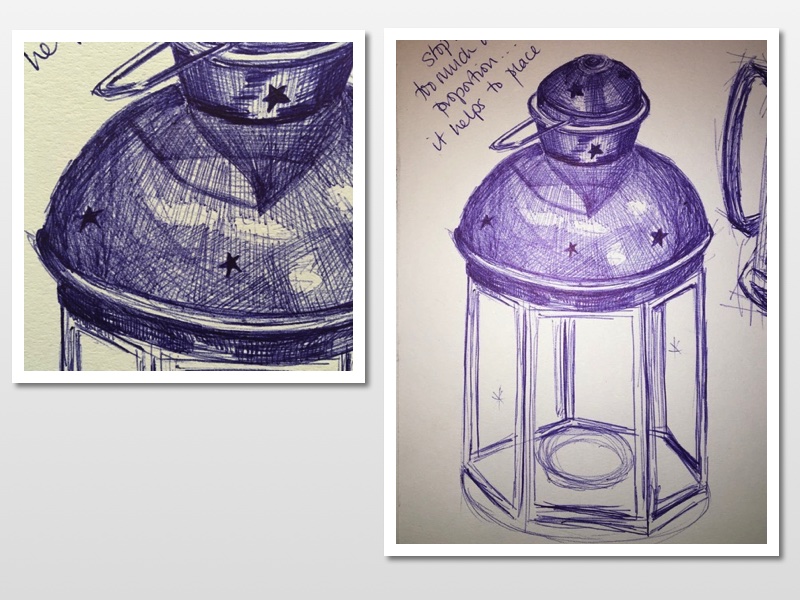
The exercise initially was hard, although maybe more for the fact that I thought it would be difficult to capture the sheen and reflections of a silver surface. I’ve been practicing this with different media just to have some playtime. I’ve never tried biro. This has a glow to it, I love it! 

As my annotation shows, the proportion is out.
It is all too easy to focus on perfection sometimes and miss the aim of the exercise!

A brushed chrome seemed harder to replicate; a diffused reflection was difficult. Maybe in charcoal?

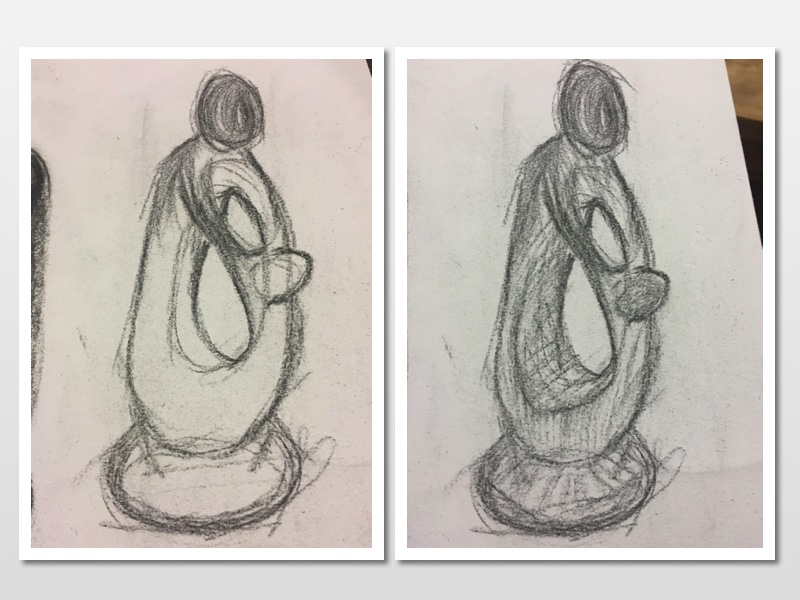
The ornament was easier initially as the reflective areas were more definitive against the contrast of the dark wood colour. However, lifting the conté to highlight the figure was not easy on such a small area – this would become easy when I work with a larger scale next for the actual exercise.

I’ve realised I need a much better quality sketchbook, this one is awful, the surface lifts and disintegrates as I wiped the conté dust with a chamois.

PART 1 PROJECT 2: Research Point 2

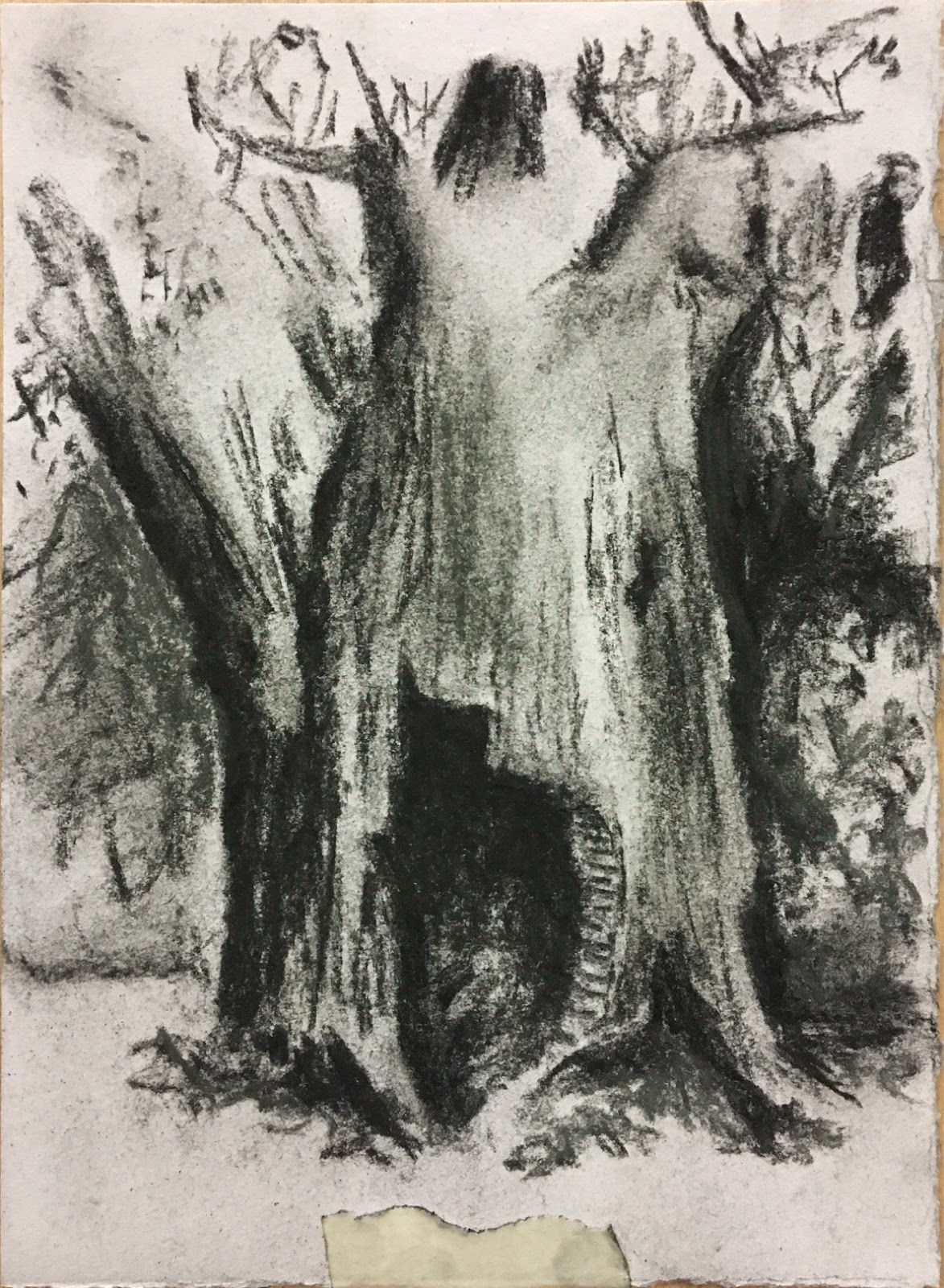
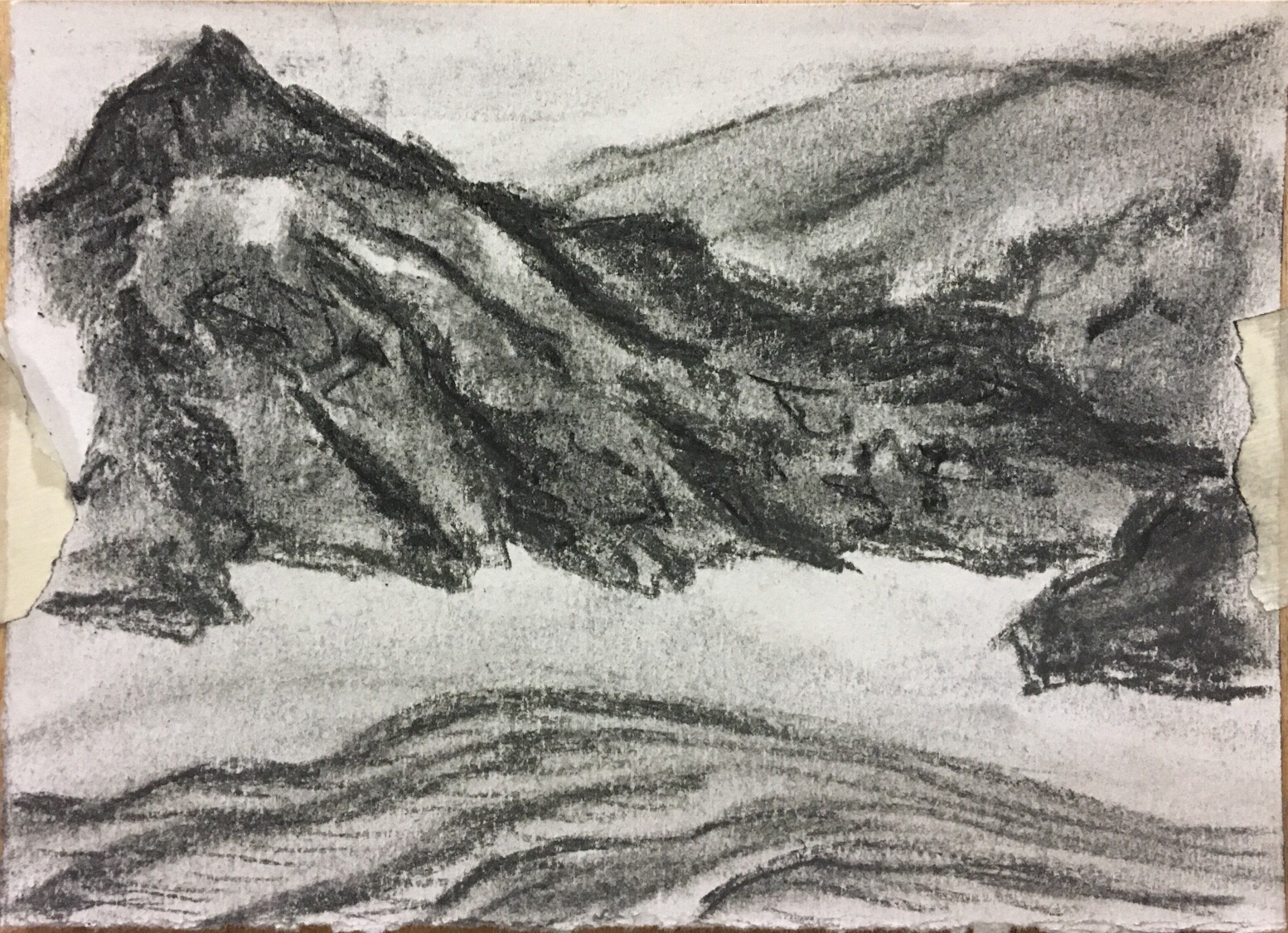
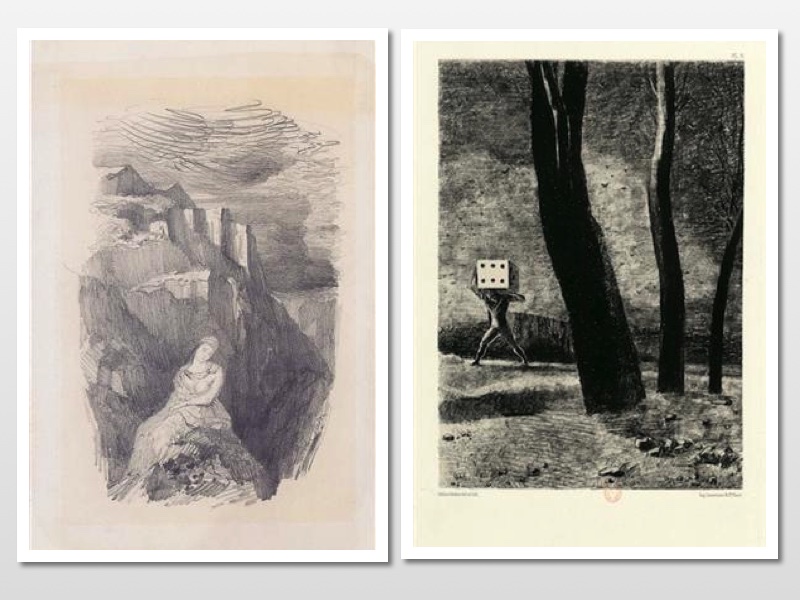
The mood of Redon’s work is deep and dreamlike, almost ethereal. To match the atmosphere, I think a soft medium such as charcoal, as Redon used, is most suitable.

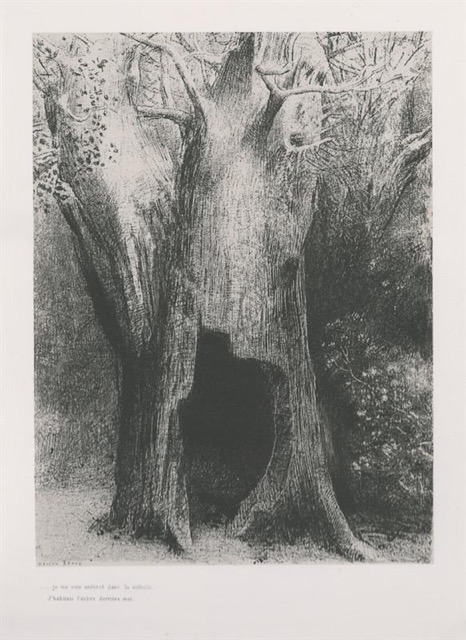
However, after completing the copy of Redon’s ‘I placed myself in Solitude’, it felt like the charcoal was almost too soft. I wasn’t gaining the texture within the drawing.  Tone is very evident but on closer study, more detail comes out of the picture. A soft, yet at the same time finer point could be needed – maybe a 4/5B pencil would have been better.


PART 1 PROJECT 2 Research Point 1

I have often, as an exercise and as a sustenance, painted an object down to the smallest accidents of its visual appearance; but the day left me sad and with an unsatiated thirst. The next day I let the other source run, that of imagination, through the recollection of the forms and I was then reassured and appeased.”                  Odilon Redon

I read this quote several times before its meaning sunk in with me. I found it apt at this stage as I often become bored or frustrated at producing a realistic piece of work because my perfectionism gets in the way. My work flows better when I create from imagination or at least if I’m using a little creativity whilst observing a still life for instance. That’s why I seemed to enjoy the group of objects exercise, looking through the objects with relation to each other’s placement.
Redon is one of the most important and original of all the Symbolist artists. His visionary works concern the world of dreams, fantasy, and the imagination. He first became famous for his noirs series, monochromatic compositions that exploit the expressive and suggestive powers of the color black. His lithographs, which often reworked earlier drawings, became a means to broaden his audience, as well as to explore in series specific themes or literary texts – he was particularly drawn to the Romantic and Symbolist works of Poe, Flaubert, and Mallarmé. Later, Redon began to slowly adopt a more colorful palette, so that his pastels and oil paintings are riotous with color, consisting largely of portraits and floral still lifes. His encounter with the Nabis introduced him to a more decorative aesthetic, and his late works incorporate Japonisme as well as an attention to flat, abstract patterns, and decorative ensembles. Redon would have an enormous impact on the art of his contemporaries, such as Paul Gauguin, as well as later modern artists like Marcel Duchamp. His lithographs and noirs in particular were admired by the Symbolist writers of the day but also by later Surrealists for their often bizarre and fantastical subjects, many of which combine scientific observation and visionary imagination.
Redon worked almost exclusively in black and white during the first half of his career. In both charcoal drawings and lithographic prints, the artist relied on the expressive and suggestive possibilities of black in his monochromatic compositions called noirs. These are some of his most famous works, and typify Symbolism in their mysterious subjects and bizarre, dreamlike inventions.
Odilon Redon, (born April 20, 1840, Bordeaux, France—died July 6, 1916, Paris), French Symbolist painter, lithographer, and etcher of considerable poetic sensitivity and imagination, whose work developed along two divergent lines. His prints explore haunted, fantastic, often macabre themes and foreshadowed the Surrealist and Dadaist movements. His oils and pastels, chiefly still lifes with flowers, won him the admiration of Henri Matisse and other painters as an important colourist.
Bertrand-Jean Redon better known as Odilon Redon (April 20, 1840 – July 6, 1916) was a Symbolist painter and printmaker, born in Bordeaux, Aquitaine, France. Odilon was a nickname derived from his mother, Odile.
Other sources:

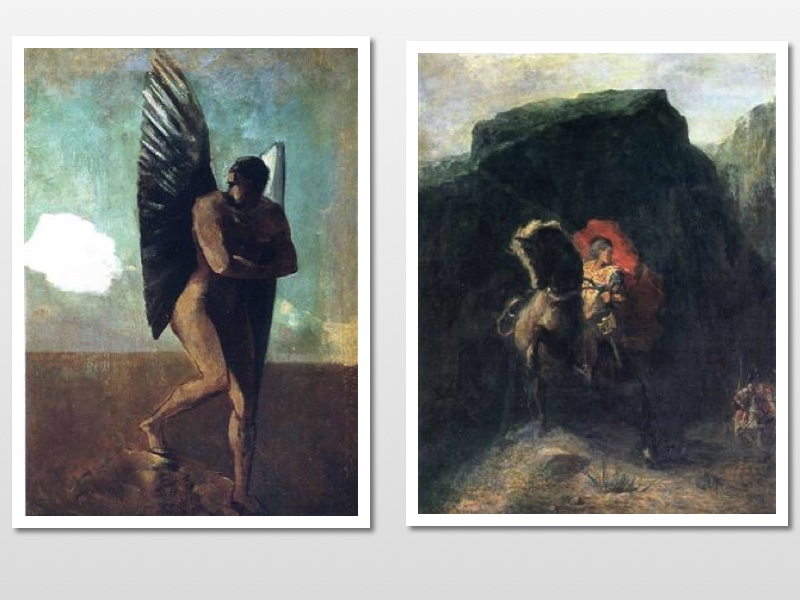
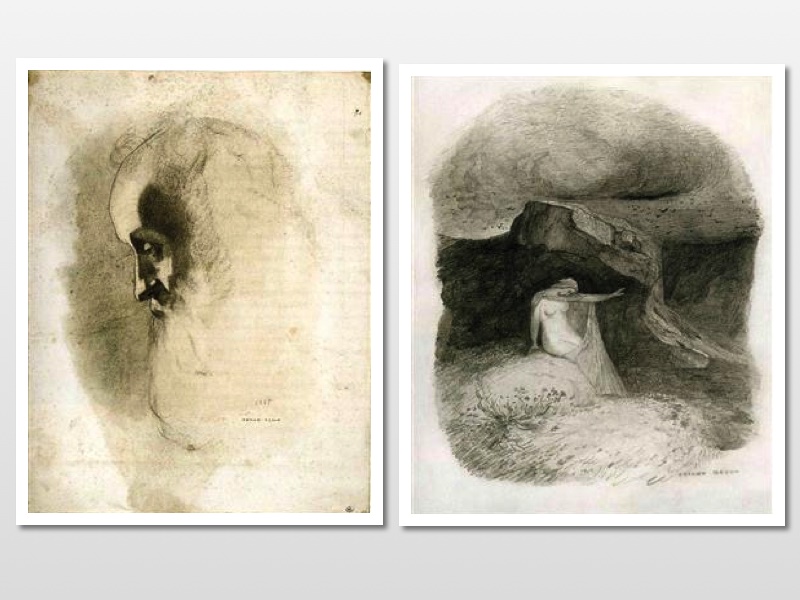
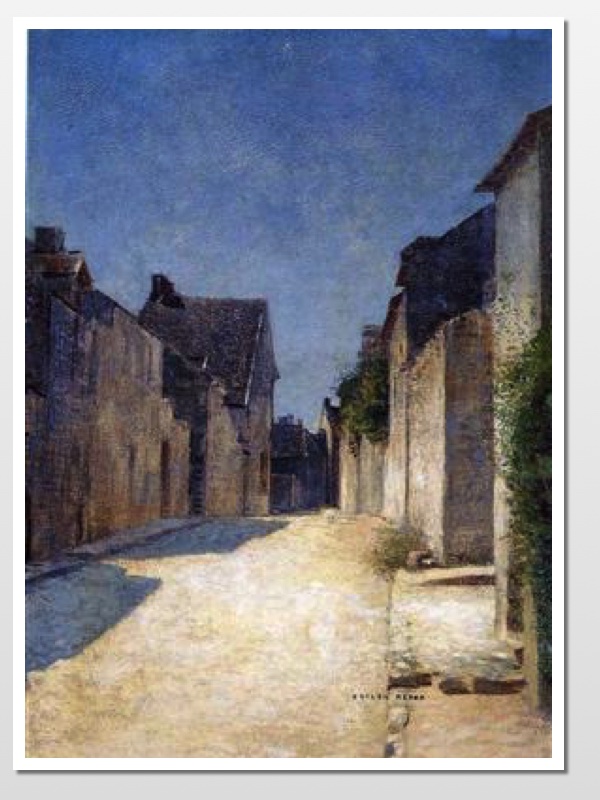
I have included a variety of his work here, not just the charcoal works. The tonal depth is also apparent in the colour pastel pieces. A definite atmosphere is emanating from the pictures.

When I study an artist, I like to try and copy a piece from a painting and then recreate my own work in the style. I am going to try ‘I plunged into solitude’ (1896) in the next post.

L: Fallen Angel looking at a Cloud 1875
R: Roland at Roncesvalles 1869

L: Rodolphe Bresdin 1865
R: Woman with Outstretched Arm 1868

Street in Samois 1888

L: Woman and the Mountain Landscape 1865
R: The Gambler 1879

Design a site like this with WordPress.com
Get started