Assignment 3 – tutor feedback

(My thoughts in green)

Overall Comments

Many thanks for sending me your third assignment. I have read through your blog which is well documented and thorough in its descriptions of your progress through the Chapter.

There is quite a difference between seeing the work on your blog and seeing it in real life and that has to do with scale , lighting , colour balance and recognising the material used. However as you have also sent the actual work it makes life easier.

This confirms my thoughts on Assignment 2, that online submission is not the ideal method. I will make a concerted effort to make sure I get the assignments posted. 

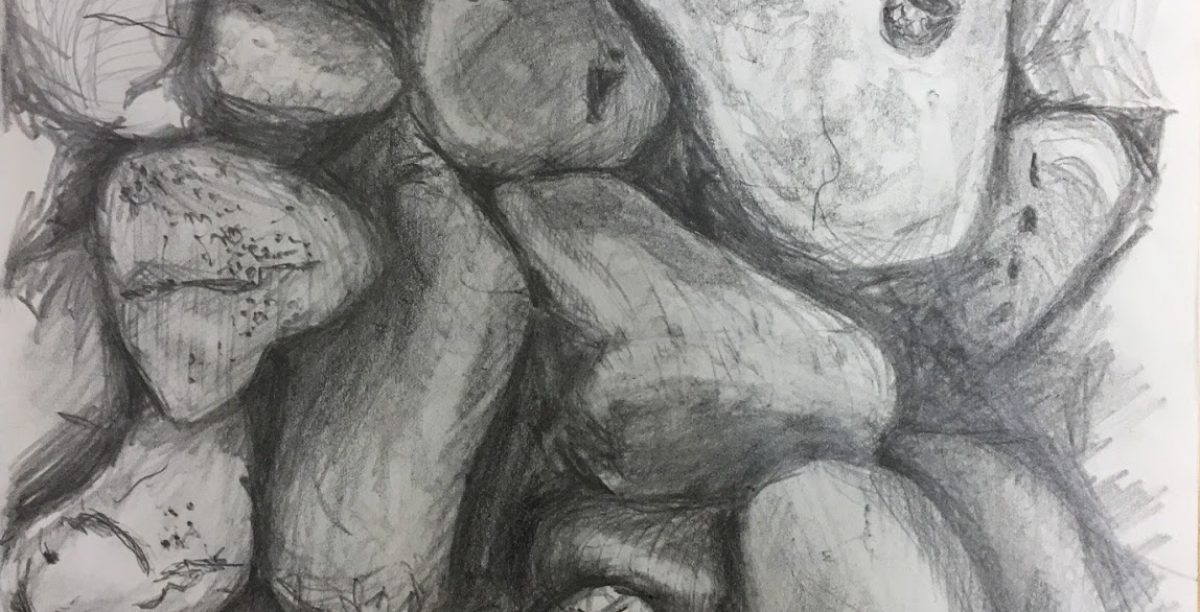
The drawing of a tree and its roots for example really stands out and the use of a blue biro to create the effects works really well. Similarly the cloud studies on black paper .You may have been inspired by Tacita Dean’s black and white drawings of mountains. They were on display in London recently but just in case you didn’t see them I’ve illustrated one here.

The name is familiar and I wonder if I came across her name and work subconsciously. I love this contrast and think I will want to use more contrasting media from here on.
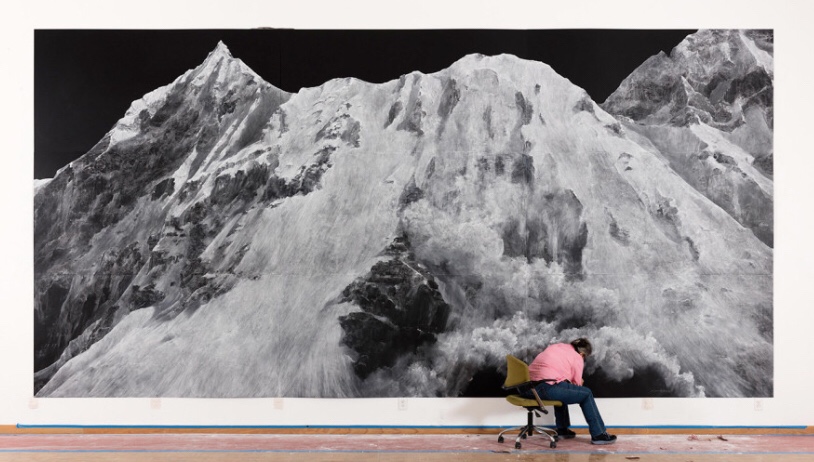
Tacita Dean

Where your pencil drawings are concerned they do not stand out as much as your ink drawings. The boldness of the hatching, and you can see that in your copy of the John Virtue  drawing, is in contrast with the lightness of touch of your pencil drawing. This may have something to do with blending pencil marks with your finger, the effects of which look more like a smudge. I couldn’t quite out my finger on what was not ‘right’.  Willow charcoal on the other hand gives a beautiful effect when spread with the finger. Using a range of pencils from HB to 6B is a possibility and gives you more of an opportunity for mark making and a variation of tone from light to dark. I oversimplified by using only one grade of pencil and varying the pressure. Your Cornish pencil landscape suffers from this lack of dynamic range. Agree. I am happy with the concept and composition but its execution has fallen short. Water-soluble pencils are also useful. I see you do use other pencils but next time you are in an art shop try out the different range and types of pencils from graphite to  charcoal and coloured  and see what you think will suit you . Graphite sticks are next on my list. I think I will use my coloured pencils more. I have a wonderful set but I still have the mindset that they are for children.

The other material you are using which you handle well is the pen and ink and watercolour that can be seen for example your sketch of Freshwater West where the whole range of tones from dark to light are used and  where the tonal range of the colours is also exploited to good effect.

Great! This is one of my favourite media and would like to work and develop this a bit more. Maybe work on my simplification.

Feedback on assignment

Demonstration of technical and Visual Skills, Quality of Outcome, Demonstration of Creativity

For your final assignment landscape,the first attempt is the better picture.  It has not only a better composition but also colour and tone and has more pictorial interest. The sketches used as  preliminary designs are informative and there are quite a number of them with some a delight in themselves. The compositional decision of having the two sets of palm trees on either side works well. The glass barrier is a good compositional device as is the use of the wavy lines that emphasis the perspective. David Hockney for example had to invent ways of depicting modern materials such as glass, sprinklers and swimming pools  and he did it by using a graphic shorthand of his own devising in his Los Angeles pictures. Further research on this needed.  Further work on this picture might be worth doing on the sand to give it more substance and possibly the  colour  and tone of the sky which could be darker at the top getting lighter to the horizon . Ah-hah…Of course. This  also helps with the Arial perspective. Otherwise the browns and ochre’s and violets used and the shadows cast are quite evocative.

Sketchbooks

Demonstration of technical and Visual Skills, Demonstration of Creativity

Your sketchbook is a delight in the combined use of written and visual information. I like very much the drawing of lobster pots , the Cornish sea and rocks and especially ‘Callen at Wave crest” an intense use of blue biro and dramatic composition. The colour blue reminds me of an artist called Lisa Brice who was recently on at the Tate Britain who has used the colour blue among other things to demonstrate the use of  the product ‘Ricketts Blue powder’ that was associated with  skin lightener  in the Caribbean. More information can be found here Wowsers! Almost a negative photographic feel. 

https://www.tate.org.uk/tate-etc/issue-43-summer-2018/lisa-brice-art-now-interview-aicha-mehrez
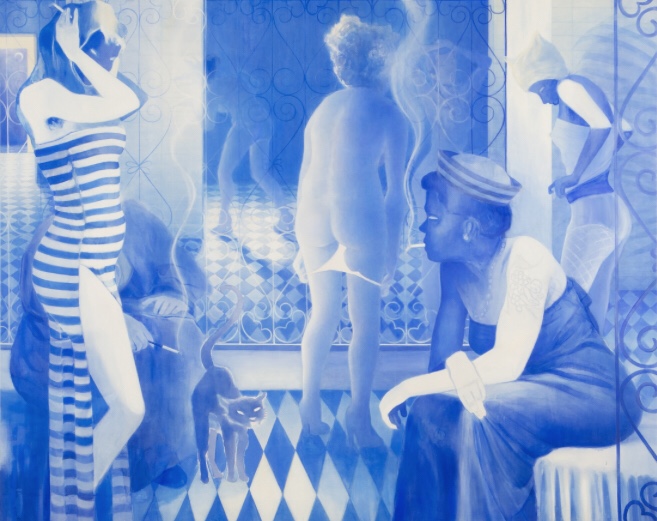
 Lisa Brice

Research

Context, reflective thinking, critical thinking, analysis

Your research is good  but It is worth thinking about the Ron Lawson picture you have illustrated beside the Hopper picture.  The former has a graphic quality that is designed to ring certain bells through its flat and attractive colour range. It is knowingly commercial in its appeal and through these devices attracts attention at first sight. There is nothing wrong with creating a commercial product of course but the Edward Hopper is in a different league altogether and it would not make a good fridge magnet although I do have another one on my fridge. There is a deeper psychological level to a Hopper painting that marks him out as one of the great painters of the 20th century . He is not using easy colours or attractive brushmarks and design to make his statement and that is an important difference. Being able to recognise this difference will become more important as you progress. I completely agree with this, again, in hindsight. I analysed ‘Nighthawks’ in my Creative Arts module and yes, he was in a league of his own. I feel a little guilty to have ‘commercialised’ Hopper in this comparison. However, the scientist in me comes to the fore and questions WHY he is in a league of his own. I feel Lawson’s techniques and colour contrast are beautiful and yet Hopper is classed as such a vital painter with comparatively dull colours. This is the point I feel my tutor is making. He is not using EASY colours or attractive techniques in his statement. Need to remind myself about Hopper’s statements. Relevant to the time in which he worked.

As I am unable to take a History of Art module now, this research needs to come in my own time.

Although of course we distain monetary values in art, (unless we are on the receiving end) check out this article about the most expensive Hopper sold at auction.

https://www.bbc.co.uk/news/entertainment-arts-46205604

Learning Logs or Blogs/Critical essays

Context, reflective thinking, critical thinking, analysis

If you are unable to see exhibitions where you are, the Internet can supply you with all the information you need for your leaning log.

Suggested reading/viewing

Context

At present in London there is an exhibition of Egon Schiele and Gustav Klimt drawings, The BBC has put out a good film on Schiele which you can probably get on I Player.

Its called Igon Schiele: Dangerous Desires

I had downloaded this before this assessment came through! It was intriguing and inspirational. Putting the distressed or pornographic feel of some of his work aside, I have always enjoyed the flow through his drawings, and wanted to emulate his relaxed line.

https://www.bbc.co.uk/iplayer/episode/b0brzkrh/egon-schiele-dangerous-desires

Pointers for the next assignment

● Reflect on this feedback in your learning log.

Well done, I look forward to your next assignment.
Assignment 3 and Reflection


Draw an outdoor scene of your choice. Try to find a view that includes some natural objects – trees, shrubs, pot plants, fields, garden plants. Also try to find a view that will allow you to demonstrate your understanding of aerial or linear perspective – in other words a view that has some demonstrable depth to it. Look for a view that offers an opportunity to draw straight- lined objects as well as items drawn from nature: buildings, walls, fences, gates and so on. This may seem like a lot to look for, but most views from windows and doors will offer you a bit of all of these things.

Do some preliminary drawings in your sketchbook to experiment with the composition.Try different versions, eliminating and moving objects if necessary to create a pleasing composition. Make some sketches to practise getting the perspective of the scene right. How are you going to create depth? Are you going to use receding lines (linear perspective) or use graduated tone (aerial perspective) and the receding size of objects, people and buildings?

Next do some broad sketches in charcoal or diluted ink and brush and trial other media before you select which to use. Think about the atmosphere and energy of the place and whether you’ll be able to give a sense of this through your chosen material and approach to mark- making.

With an A2 or A1 sheet of paper pinned or taped on a board or on a pad, get settled comfortably and keep your preliminary sketches around you for reference. Think about your successes in previous exercises and look very carefully at the scene in front of you. You should spend anything up to two hours on this final drawing, not including all the preliminary work you’ve already done.

Demonstration of technical and visual skills – materials, techniques, observational skills, visual awareness, design and composition skills

I continue to notice an increased confidence in my composition skills; I feel I have more of an eye for balance and this is happening earlier on rather than it taking over the exercise. My observational skills are also developing further – I am becoming more tuned in and thinking about how I could intepret what I see and what materials may work best. I don’t feel I have experimented with materials to the fullest as I would have made myself fall behind more than I already was. I feel my mark-making and final work is too formal, and so the techniques need to be simplified. As I become more relaxed I think that my techniques will broaden.

In attempt 1, I think I have lost the technicality with trying to represent the distance haziness of the buildings. In hindsight, I would not have started with a pen and ink outline as I ended up trying to cover this up with white and grey pastel. I would like to be less formal in this.

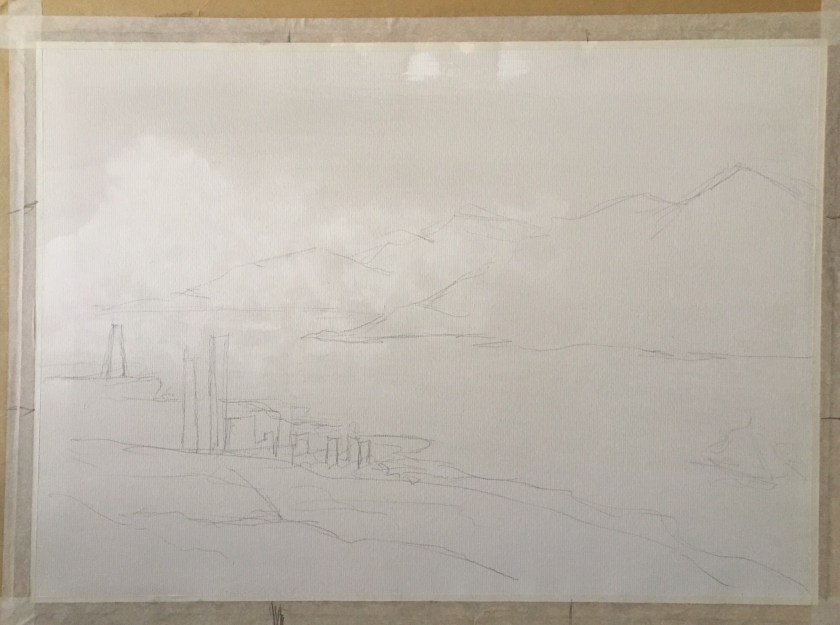
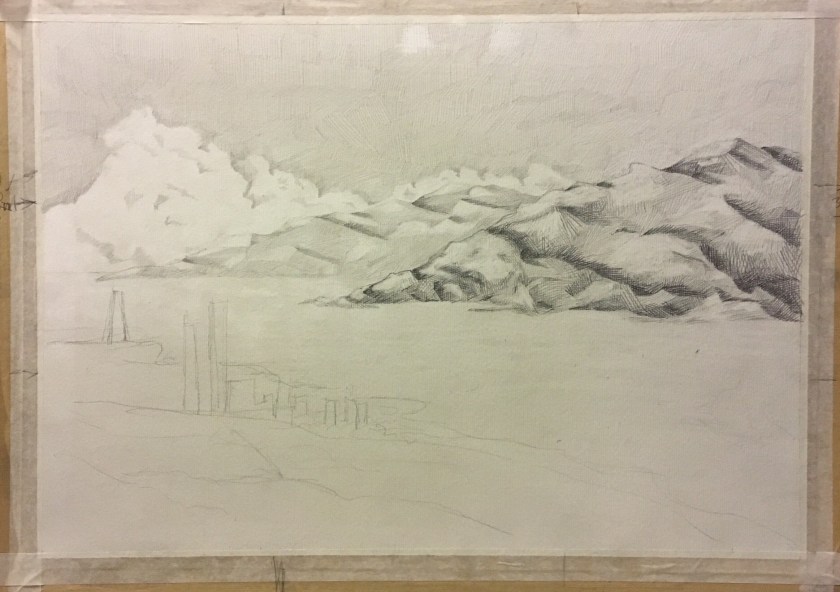
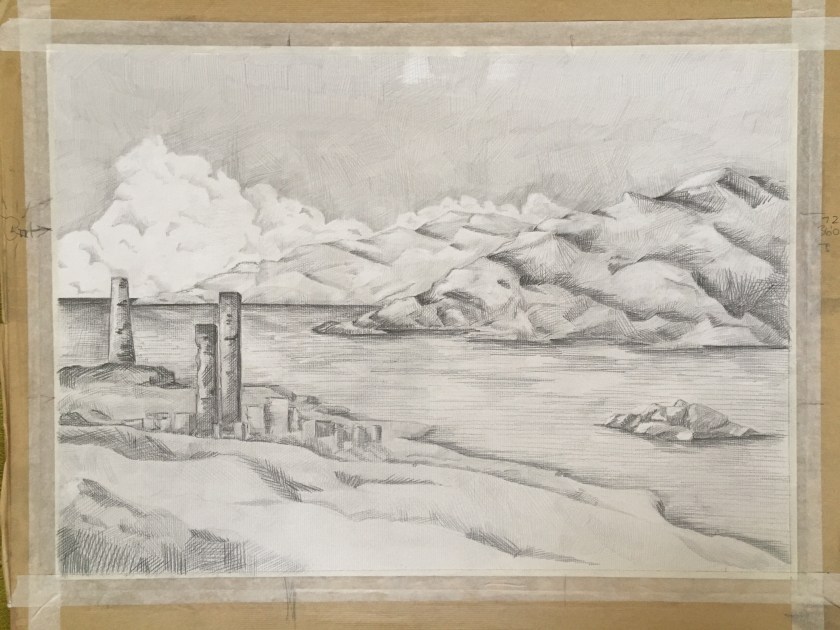
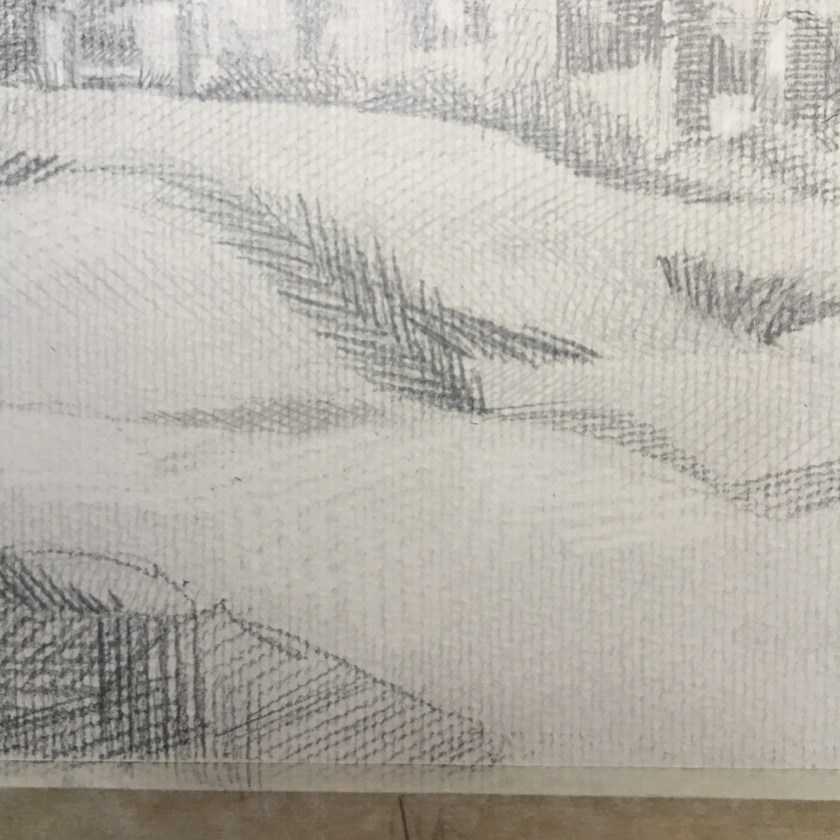
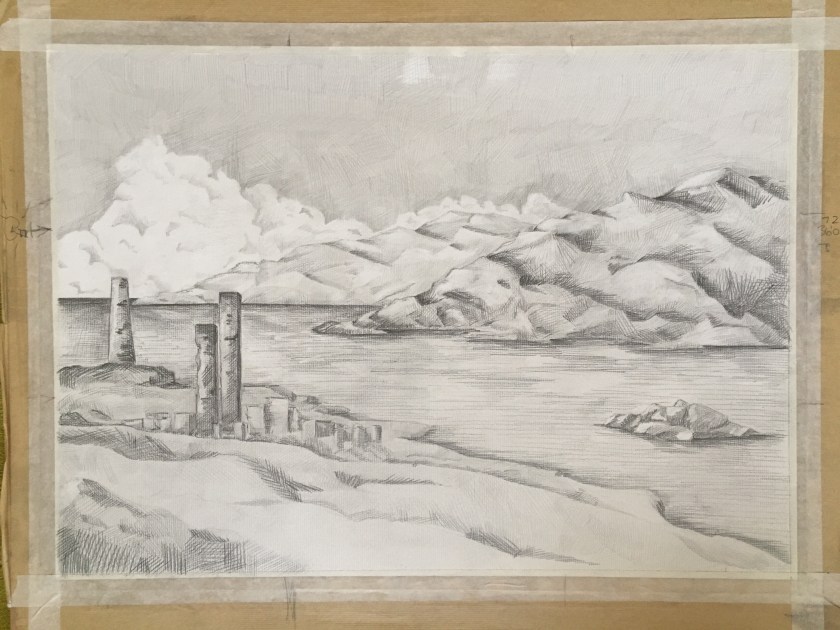
In attempt 2, more attention could have been paid to the size of marks in relation to the perspective, i.e. smaller further away. The marks on the first distant hill are the same as the marks in the foreground. I noticed this after as something was not quite right – the first hill seemed closer than I wanted it to be. I also need to think how the shadows of the towers should fall across the undulating ground.

I liked how I used the electric eraser in the same way as a pencil, making the same linear marks to create highlights. I also like the texture of the water colour paper. Definitely will try this in pen and ink in the style of John Virtue.

The atmosphere and energy of each setting was high up on my list when I was developing each piece. Particularly in attempt 2, the energy was running alongside my ideas and drawing the whole time. It consisted of elements of landscape from my holidays in Ireland and Cornwall, both spiritually energetic places anyway.

Quality of outcome – content, application of knowledge, presentation of work in a coherent manner, discernment, conceptualisation of thoughts, communication of ideas

Both attempt 1 and 2 are still formal pieces, 2 less so. I risked overworking the first one in particular by trying to make it look realistic; I have tried to include everything so that there is no risk of the viewer losing any context or perspective; despite there being no chance of this, I still got hung up on this. It took longer than 2 hours and I was still seeing things to change. Realising this and asking myself the question should I simplify my choices more, led me to attempt the assignment a second time. I was not satisfied and needed to create something  more fluid, especially after my Virtue research. For me, it became more of a case of simplifying the techniques rather than the content.

I am more satisfied with attempt 2, I relaxed more and this helped as I had more of a direction by following Virtue’s drawing style. This piece has less preliminary work carried out, I just wanted to get the idea out on paper. Although this did still take longer than 2 hours…

This is one I will work on again for assessment; I can already see what I need to do. I just hope I remember to not over-formalise it.

Demonstration of creativity – imagination, experimentation, invention, development of a personal voice

I think I am becoming more practised at the work for the assignments – I am getting my head in the game three assignments in!

There is no doubt I am tuning into my imagination, but on the other hand I often feel I get carried away with some many ideas and processes running through my mind. With that in mind, the chaos may be in my head but I think I communicate well enough to plan and narrow down my thoughts. I am becoming braver with experimentation of materials but I don’t think I’m experimenting to the fullest potential.

I am inspired by so many artists, works of art, and colours and objects around me and at this point I have an amazing exhibition of my work in my mind! To get these ideas out with the investigation and experimentation needed, would require me becoming a full-time artist and I find that thought frustrating as ideas go untapped.

Context reflection – research, critical thinking

As far as critical thinking is concerned I need to learn how to compare, contrast and analyse pieces of work. I teach my primary school children the questions to ask about a piece of work and maybe I should bring my thinking back to basics as well.

I could be doing more research. Compared to A-level, I have got out of the habit of creating artist study pages in my sketchbook, where I would copy an artist’s technique and picture and then apply this to a piece of my own work. I need to do this more often.

I am always critically thinking, just not communicating it, it seems. I am not communicating ideas in depth on blog, as I write notes down as I go. It is all in my book and I end up uploading the photos of the pages rather than doubling my work load. I guess as long as you can read my writing that is acceptable?

Assignment 3 – second attempt

676d68f2-8586-4ea3-994b-4271c000acf0-776-0000002beb830da7_file-12018-10-22 15-23 page 5

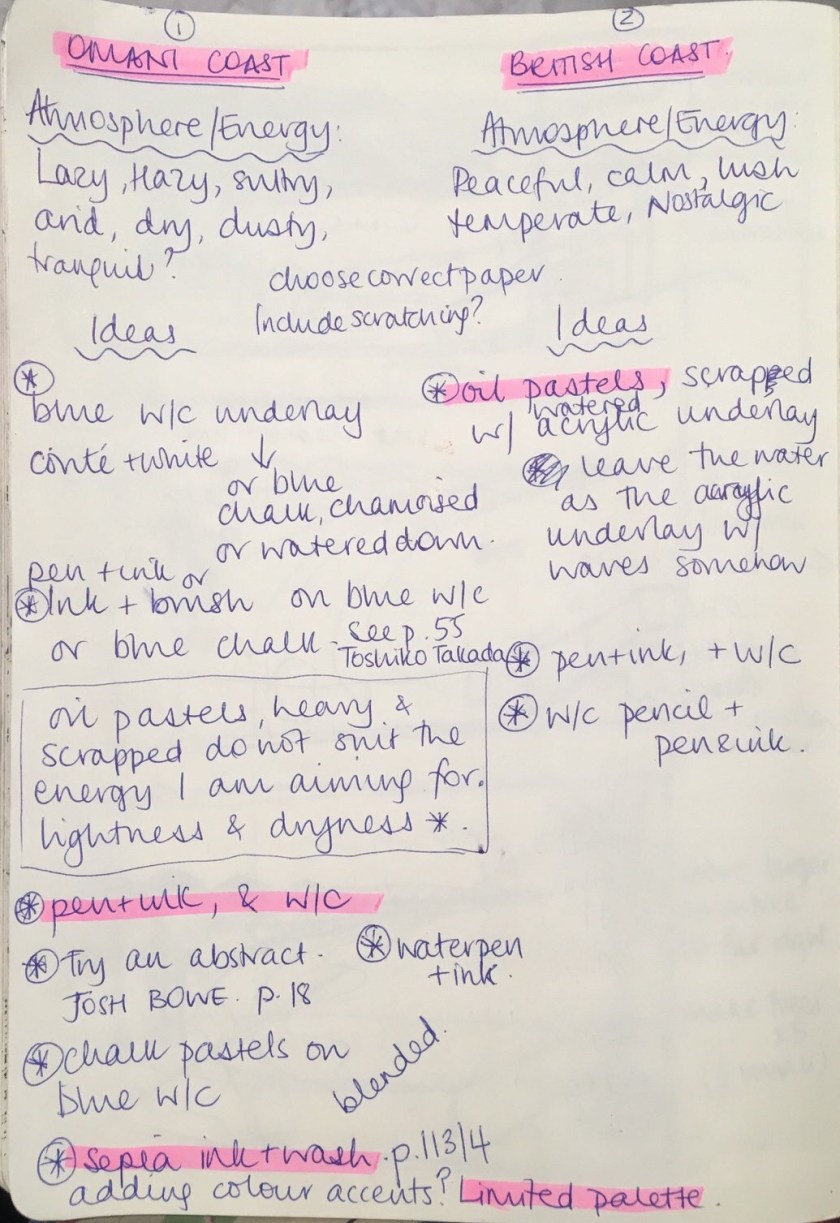
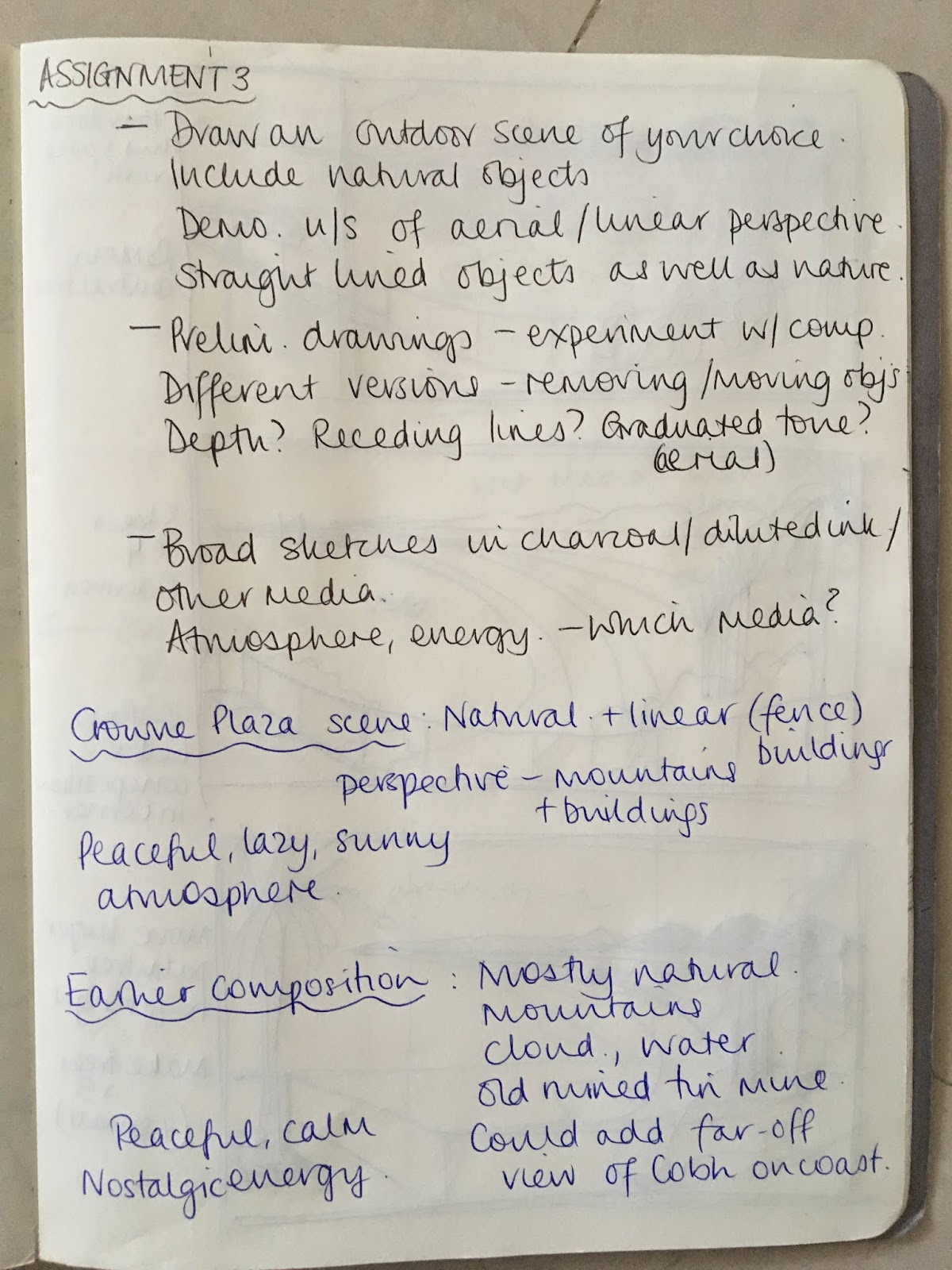
Words I would associate with this landscape would include peace, tranquil, lush, temperate; a calm energy. Originally I wanted to follow the lush and temperate feel by using thick, ‘full’ medium of oil pastels, texture could be scrapped into the oil pastel with a wash over the top.

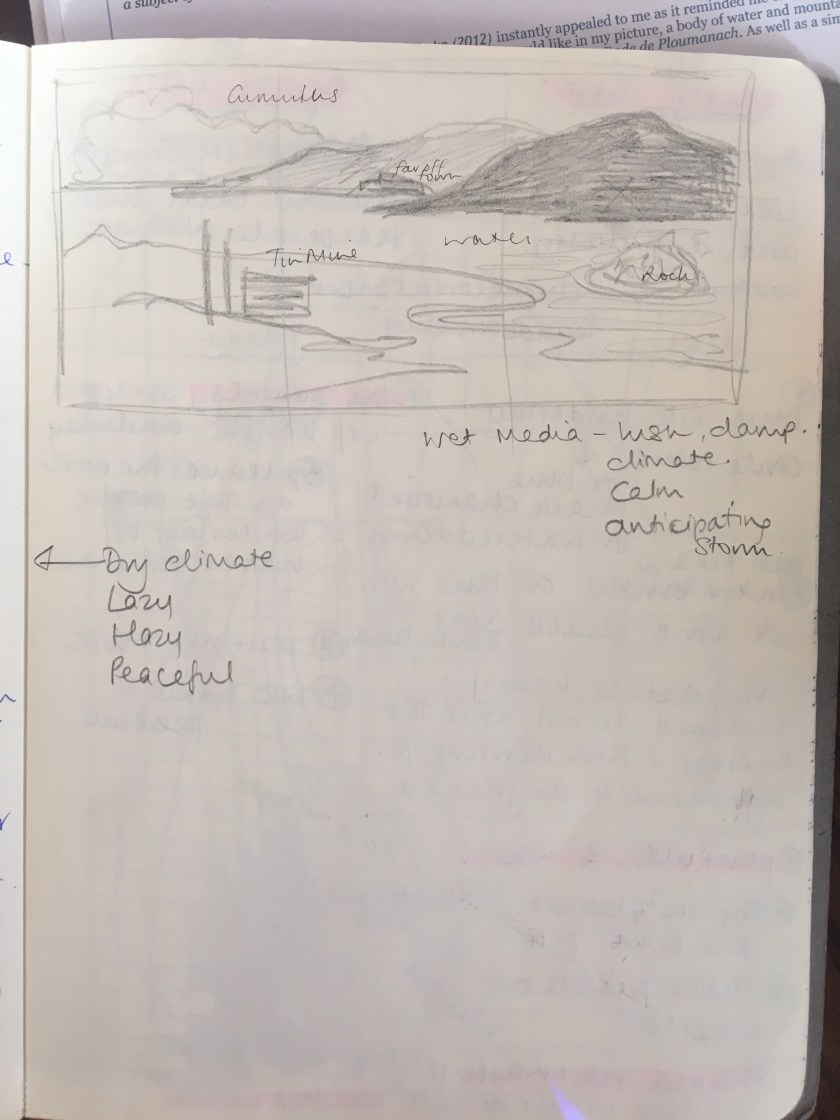
I had three ideas forming – oil pastels, textured, and wash; watercolour pencils and pen and ink; pen and ink and watercolour. I considered the oil pastels as they offered an unpredictability and a full thickness to match the lush feel of a temperate landscape. However, in the end I chose not to go this route after I lost myself in John Virtue’s tonal pencil drawings from the 1970s.

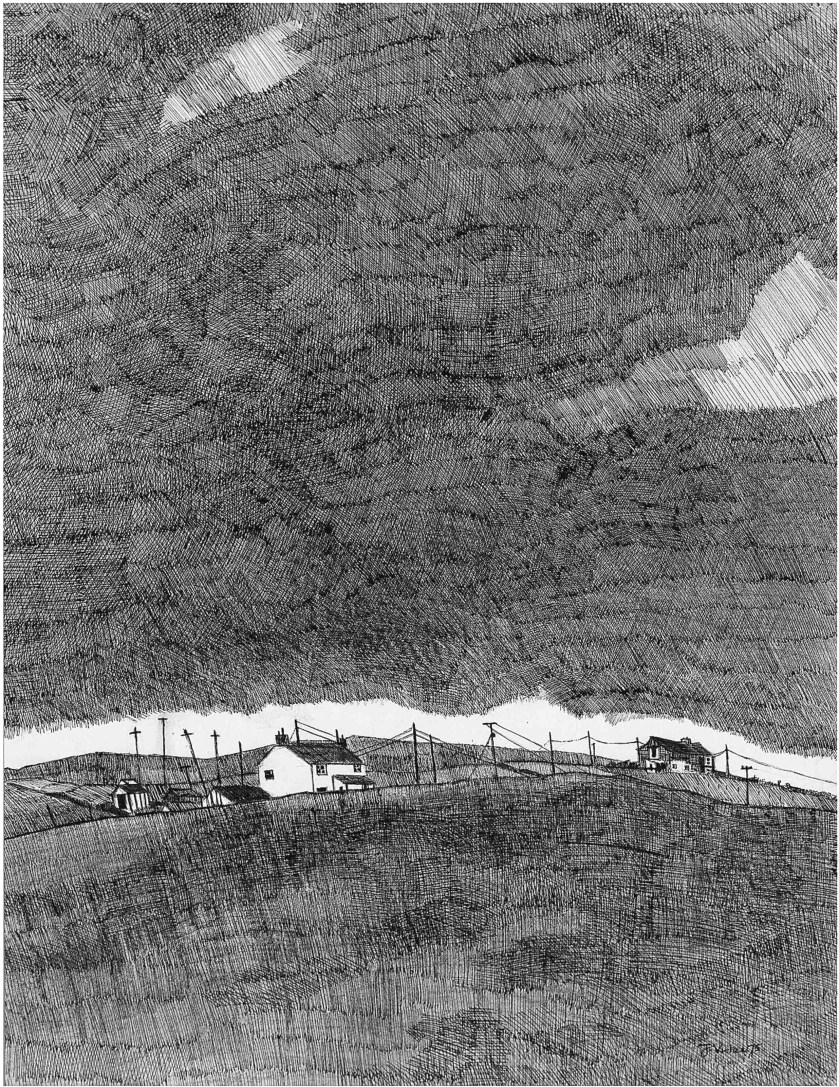
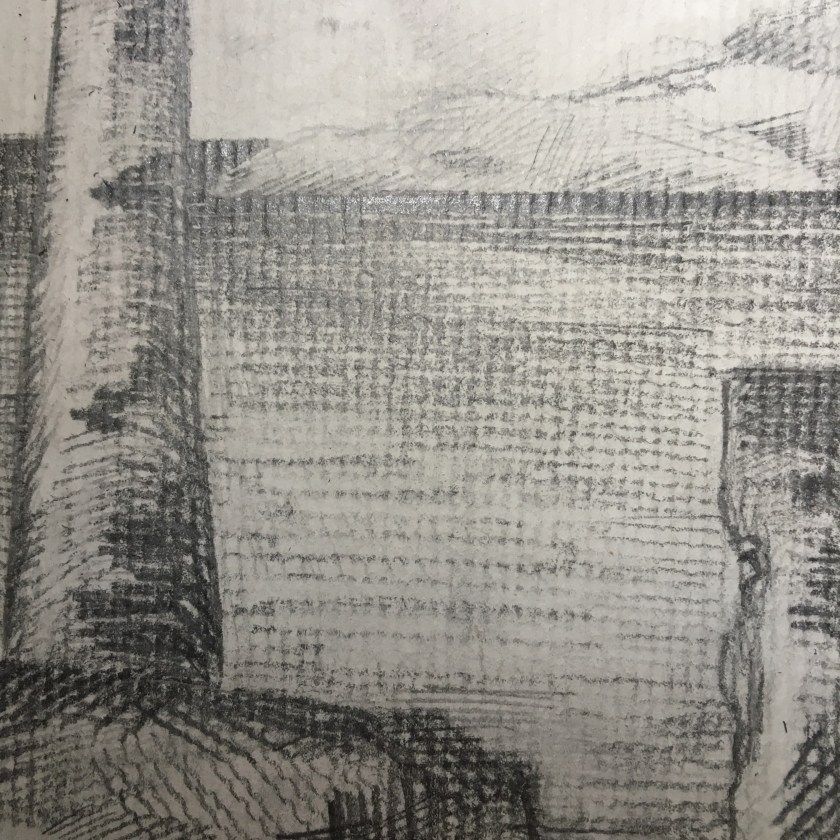
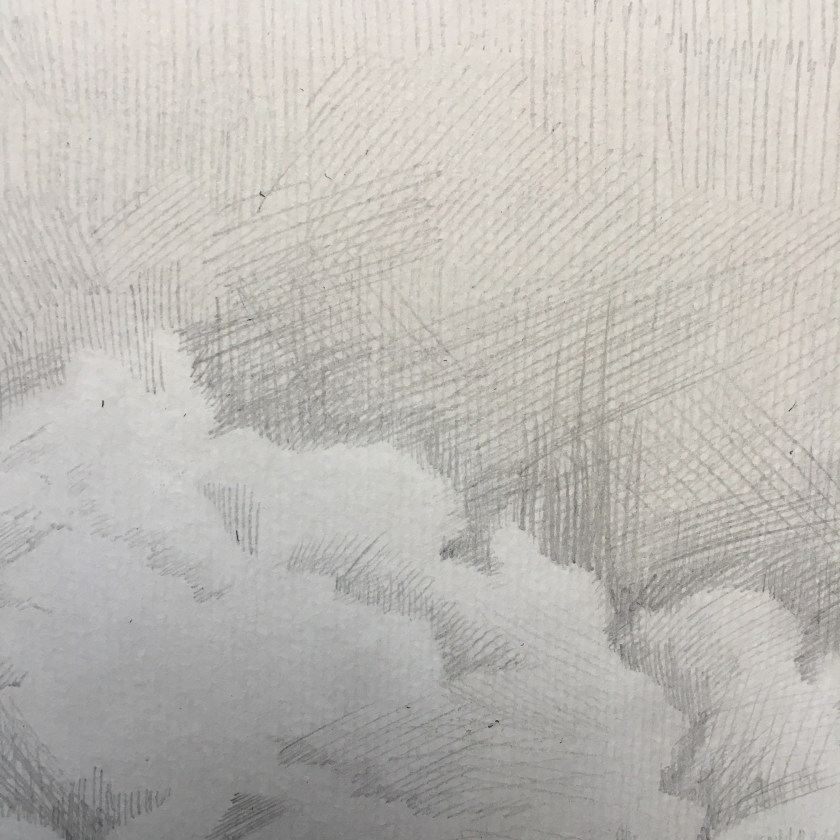
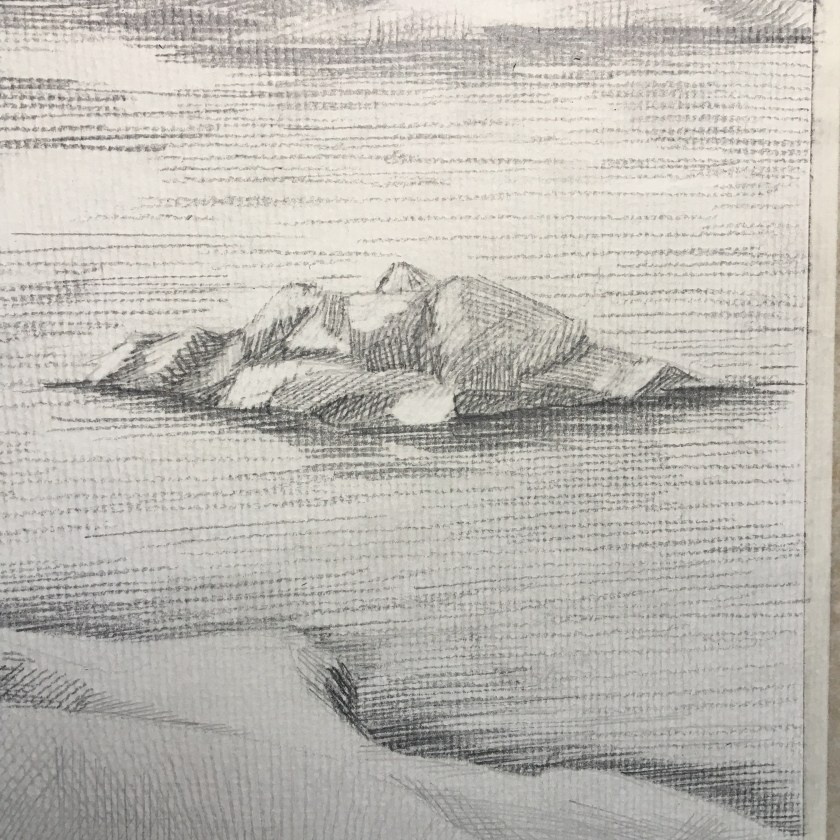
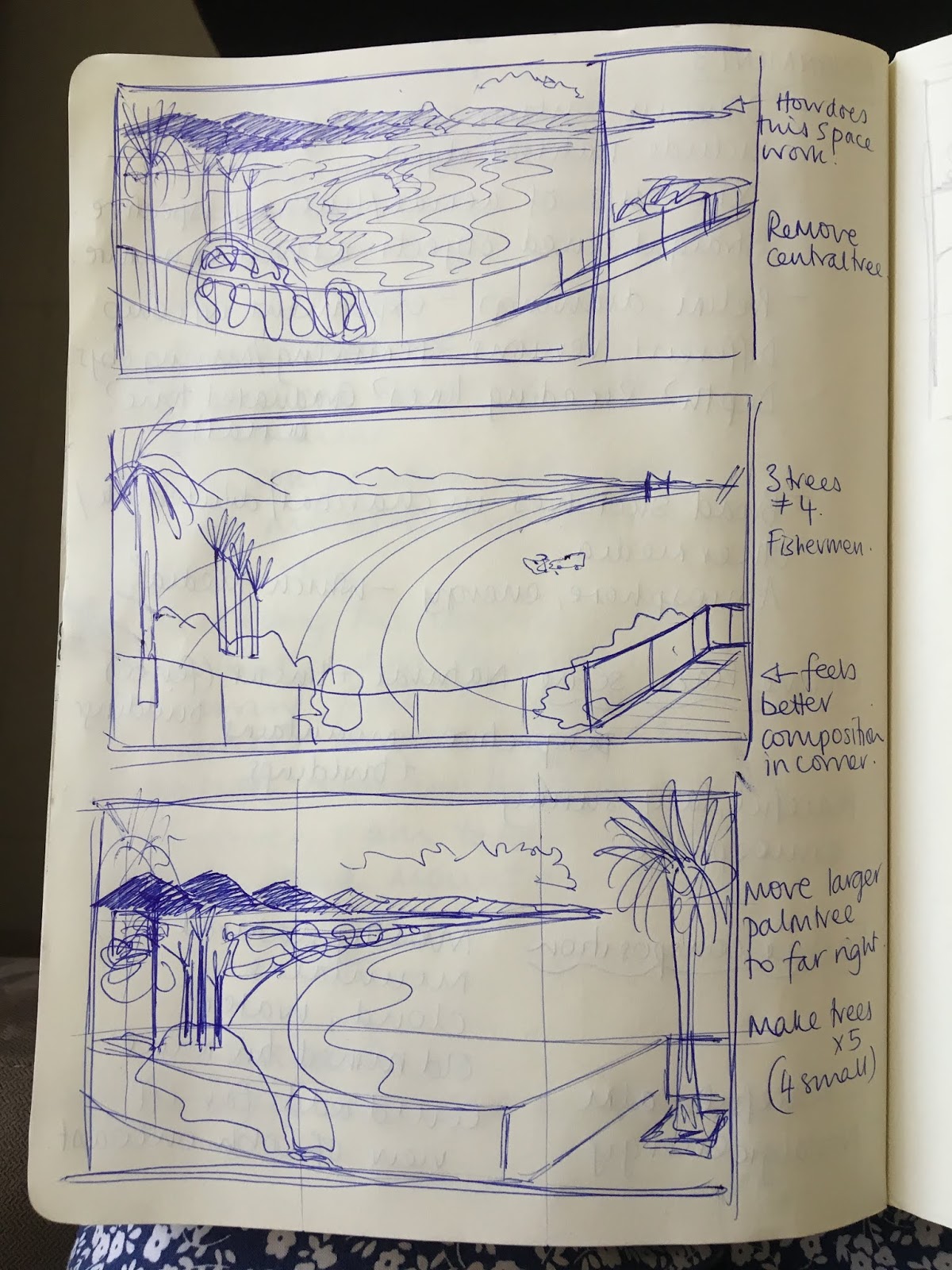
I know that one of the points in the assignment outline was to create preliminary drawings for this assignment. I worked on basic composition but wanted to get this piece out in its simplicity, with John Virtue in mind the whole time. Hence I knew I would work with pencil only. I might have added ink if there were any distinct, man-made lines, like the telegraph poles in Green Haworth from South. I did not want to risk overworking this piece and I am a lot happier this time round. Not satisfied entirely, I’d like to continue practicing building and layering the Virtue-style marks to create depth as well as tone but for now, I need to step away and move on.

My inspiration:

https://www.christies.com/lotfinder/Lot/john-virtue-b-1947-green-haworth-5484636-details.aspx

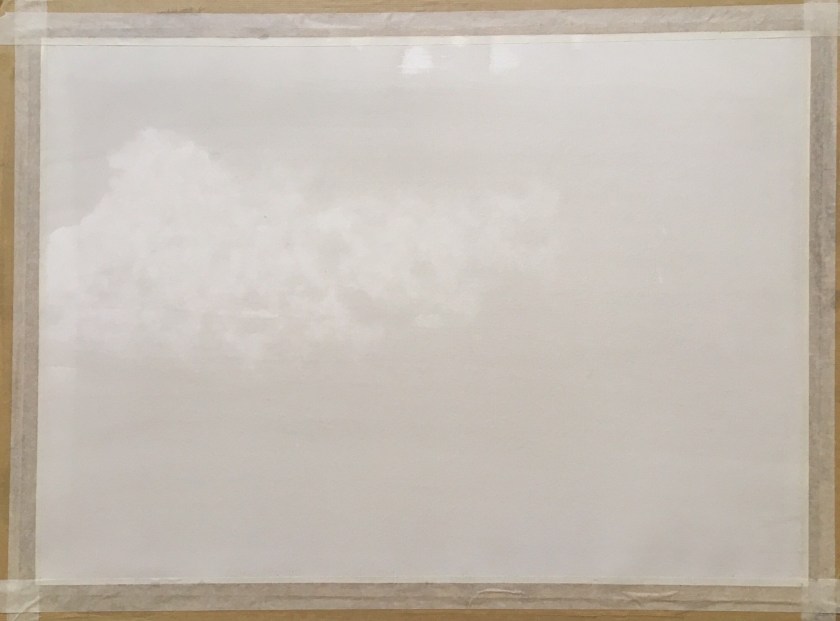
Below are photos from the process, plus the earlier composition ideas I had. I started with a black ink wash, with the cloud area tissued away. Ink does not seem to react to this as well as black watercolour may have done as I was looking for more of the delicate cloud edges to appear from the tissue. Nice enough though.

I’d like try this again with pen, ink and wash.

Design a site like this with WordPress.com
Get started